
Anthony ZürcherNorth America Correspondent
 EPA
EPAReports of an imminent summit between the leaders of the United States and Russia have been greatly exaggerated, it appears.
Just days after Donald Trump announced plans to meet with Russian President Vladimir Putin in Budapest – “in about two weeks” – the summit was suspended indefinitely.
A preliminary meeting between the two countries’ top diplomats was also canceled.
“I don’t want to have a pointless meeting,” President Trump told reporters at the White House Tuesday afternoon. “I don’t want to waste time, so I’ll see what’s going on.”
The on-again, off-again summit is just the latest twist in Trump’s efforts to end the war in Ukraine – a subject the US president has renewed his focus on after reaching a ceasefire deal and release of hostages in Gaza.
While making remarks in Egypt last week to celebrate that ceasefire agreement, Trump turned to Steve Witkoff, his top diplomatic negotiator, with a new demand.
“We have to put an end to Russia,” he said.
However, the circumstances that made a breakthrough in Gaza possible for Witkoff and his team may be difficult to replicate in a war in Ukraine that has raged for nearly four years.
Less leverage
According to Witkoff, the key to unlocking a deal was Israel’s decision to attack Hamas negotiators in Qatar. The move infuriated the United States’ Arab allies but gave Trump leverage to pressure Israeli Prime Minister Benjamin Netanyahu into a deal.
Trump has benefited from a long history of support for Israel dating back to his first term, including his decision to move the US embassy to Jerusalem, changing the US position on the legality of Israeli settlements in the West Bank and, most recently, his support for Israel’s military campaign against Iran.
The US president is actually more popular among Israelis than Netanyahu – a position that gives him unique influence over the Israeli leader.
Add to that Trump’s political and economic ties to key Arab players in the region, and he had a wealth of diplomatic power to force through a deal.
In contrast, in the war in Ukraine, Trump has much less influence. Over the past nine months, he has oscillated between attempts to strengthen Putin and then Zelensky, all with no apparent result.
Trump has threatened to impose new sanctions on Russian energy exports and provide Ukraine with new long-range weapons. But he also acknowledged that it could disrupt the global economy and make the war even worse.
Meanwhile, the president has publicly rebuked Zelensky, temporarily halting intelligence sharing with Ukraine and suspending arms shipments to the country — only to back down in the face of worried European allies who warn that a Ukraine collapse could destabilize the entire region.
Trump loves to tout his ability to sit down and make deals, but his face-to-face meetings with Putin and Zelensky have not seemed to bring the war any closer to a resolution.

 Getty Images
Putin may actually be using Trump’s desire to reach a deal — and his belief in in-person negotiation — as a way to influence him.
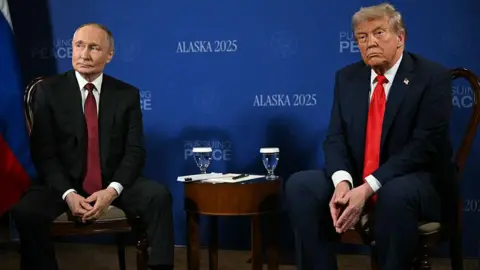
In July, Putin agreed to a summit in Alaska just as it seemed likely that Trump would approve the congressional sanctions package backed by Senate Republicans. This legislation was later suspended.
Last week, as reports circulated that the White House was seriously considering shipping Tomahawk cruise missiles and Patriot anti-aircraft batteries to kyiv, the Russian leader called Trump, who then touted the possibility of a summit in Budapest.
The next day, Trump welcomed Zelensky to the White House, but left empty-handed after a seemingly tense meeting.
Trump insisted he was not being played by Putin.
“You know, I’ve been played my whole life by the best of them and I’ve done really well,” he said.
But the Ukrainian leader then took note of the unfolding events.
“As soon as the issue of long-distance mobility became more remote for us – for Ukraine – Russia almost automatically became less interested in diplomacy,” he said.
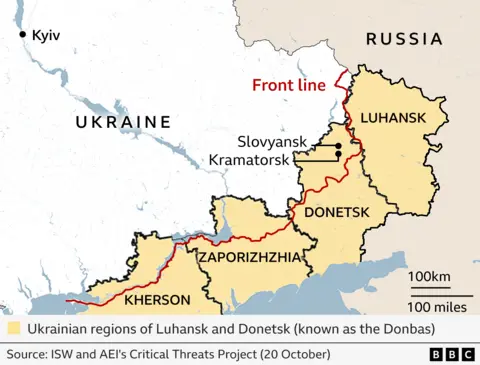
So, in a matter of days, Trump went from the prospect of sending missiles to Ukraine to planning a Budapest summit with Putin and privately pressuring Zelensky to cede all of Donbass – including territories that Russia was unable to conquer.
He ultimately decided to call for a ceasefire in the current fighting – something Russia has refused to accept.
During his election campaign last year, Trump promised he could end the war in Ukraine within hours. He has since backed away from that pledge, saying ending the war is proving more difficult than expected.
It is a rare recognition of the limits of its power – and of the difficulty of finding a framework for peace when neither side is willing, or can afford, to give up the fight.


