
Milliseconds[{” attribute=”” tabindex=”0″ role=”link”>pulsar binaries may produce the excess 511 keV photons seen in the galaxy. These systems could expose hidden pulsars and even exoplanets.
Many astrophysicists devote their work to tracing the origins of photons, since certain types are closely linked to specific cosmic processes. Identifying where these photons come from could help resolve major questions in astrophysics. One particularly intriguing case involves photons on the “511 keV line,” which appear in unusually high numbers near the galactic core.
No single known source produces them in sufficient abundance. A recent study by Zachary Metzler and Zorawar Wadiasingh, from the University of Maryland and NASA’s Goddard Space Flight Center, proposes that millisecond pulsar (MSP) binaries may be a significant contributor.
The significance of 511 keV photons
Why are 511 keV photons so important? The name refers to their energy level, 511 kiloelectronvolts, which corresponds to a wavelength of 2.427 picometers—placing them firmly in the gamma-ray portion of the electromagnetic spectrum. What makes them special is that they are produced through what is known as the “annihilation line.”
Despite the ominous sound, “annihilation” here describes the collision of a positron and an electron. When these oppositely charged particles meet, they are converted into energy in the form of 511 keV photons. If researchers can determine what is generating the excess of these photons near the galactic center, they will also uncover a plentiful source of electron-positron annihilation.
Possible astrophysical sources
Many possible origins for 511 keV photons have been suggested, including binary jet X-ray systems and even dark matter annihilation. However, Drs. Metzler and Wadiasingh argue that a particular type of binary pulsar could play a major role. These systems, known as millisecond pulsar (MSP) binaries, contain a pulsar that spins once every few milliseconds. Such pulsars are already remarkable because of the extreme physical forces involved, but when paired with a companion star—which does not necessarily need to be a pulsar—the interactions become even more complex and intriguing.
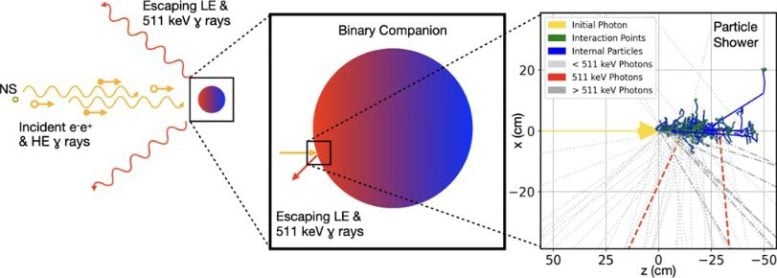
In their study, the authors modeled several configurations of MSP binaries. Their results revealed distinctive features that they suggest are worth investigating with next-generation gamma-ray telescopes and gravitational wave detectors, since combining both observational methods would provide the clearest picture of MSP binaries. They highlight three specific avenues of discovery as particularly promising.
Clues to exoplanets and star composition
First, the authors believe details about any accompanying exoplanets could be discovered by analyzing the output of an MSP binary. The 511 keV signal can fluctuate based on the system’s orbital dynamics, creating red/blue shifts as the stars move around each other, and possibly around a possible exoplanet. Additionally, astronomers can learn about the composition of the companion star in the system by analyzing changes in the “production efficiencies” of 511 keV photons, which vary with the types of material present in the companion star. Those orbital dynamics and material composition information could reveal potential exoplanets being harbored in the system.
https://www.youtube.com/watch?v=EYDNZZZZ
A second potential avenue for research is the search for “ultra-compact systems”, where the MSP and its companion star are very close. These are normally ignored in Pulsar surveys, because the algorithms used to search through astronomical data cannot analyze the interactions between the two stars to differentiate them, which makes it essentially a partial dead angle in astronomical literature.
However, ultra-compact systems with MSPS would create massive lines of 511 Kev, because the pulsar beam would pass over the exterior atmosphere of its complementary star, covering a lot of surface. This leaves a lot of room for electronic / positron annihilation, and therefore many 511 Kev photons, which should be significantly stronger in these binary configurations.
Revealing hidden pulsars
The bundle of a pulsar also leads to the third discovery of the pulsars themselves, whose beam does not pass on the earth. As a rule, pulsars are discovered because their “bundle” of energy passes directly on earth, and our detectors manage to collect all the energy that the beam sent, whatever its distance. However, astrophysicists hypothesize that there are many pulsars whose beams do not pass at all; Therefore, we could not collect data on them.
The MSP binaries, however, would allow us to see pulsars from a new angle – from the 511 Kev photons created when their beam strikes their companion star. These photons are not as directional as the pulsar beam itself, so even if the beam does not point directly to the earth, at least some of the 511 Kev photons of the annihilation of the electrons in the high atmosphere of the star – allowing us to identify tangentially that a pulsar hits the star with its high power bundle.
As the authors discuss it in the article, their work is just theoretical at this stage, with modeling to accompany it. Another generation of detection instruments is online in the coming years, including the Compton spectrometer and the imagery (COSI), which should be launched in 2027. With the additional observation power of these platforms, astronomers should be able to collect enough data to test this theory and should be able to find even more of these interesting photons, regardless of their source.
Reference: “Irradiated pulsar planets and companions like 511 POSitron Kev annihilation sources” by Zachary Metzler and Zorawar Wadiasingh, September 3, 2025, Arxiv.
DOI: 10.48550 / Arxiv.2503.10511
Adapted from an article originally published on Universe today.
Never miss a breakthrough: join the Scitechdaily newsletter.


