
 Reuters
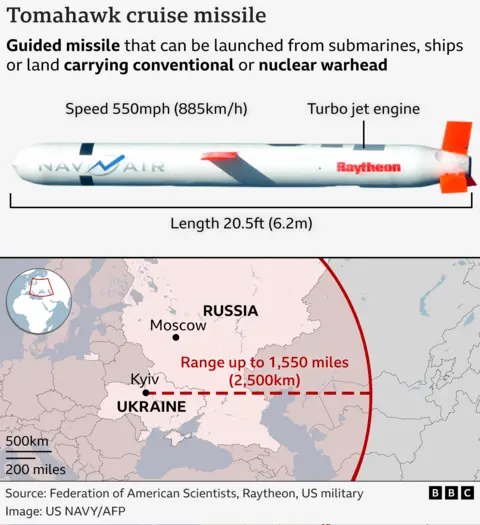
Ukrainian President Volodymyr Zelensky will meet with U.S. President Donald Trump in Washington on Friday, as Trump weighs whether to arm Ukraine with Tomahawk missiles capable of striking deep into Russia.
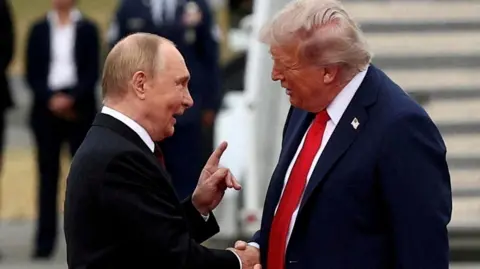
Their meeting comes a day after Trump said “great progress” had been made in a phone call with Russian President Vladimir Putin, with the two men agreeing to face-to-face talks in Hungary.
Trump said the call, the first with Putin since mid-August, was “very productive,” adding that teams from Washington and Moscow would meet next week.
As Zelensky arrived in the United States, his third visit since January, he said Moscow was “rushing to resume dialogue as soon as it hears about the Tomahawks.”
Zelensky called on the United States to provide Ukraine with advanced missiles, with a range of 2,500 km (1,500 miles).
When asked earlier this week if Trump would consider giving Tomahawks to Ukraine, he replied: “We’ll see…I might.”
But asked about the same prospect following his call with Putin, Trump said “we can’t exhaust” the U.S. stockpile of Tomahawks, adding “we need them too…so I don’t know what we can do about that.”
Writing on his Truth Social platform after his call with Putin ended, Trump said he and the Russian president “spent a lot of time talking about trade between Russia and the United States when the war with Ukraine is over.”
He said “high-level advisors” from the two countries would meet next week at an unspecified location, with Secretary of State Marco Rubio leading the U.S. delegation.
Trump also said he would brief Zelensky on his talks with Putin on Friday, adding: “I think great progress has been made with today’s phone conversation.”
He later told reporters he hoped to meet Putin in Hungary “within two weeks.”

Trump has been seen as more sympathetic toward Russia than his predecessor Joe Biden, but in recent months he has taken a harder line with Putin.
He had hoped that a face-to-face summit in Alaska in August would help convince the Russian president to begin comprehensive peace negotiations to end the war – but that meeting failed to produce a breakthrough.
They spoke again a few days later when Trump interrupted a meeting with Zelensky and European leaders to call Putin.
Trump and Putin could have another discussion a week after Rubio’s meeting with his advisers, the Hungarian prime minister said.
Viktor Orban told state radio he would speak with the Russian president later on Friday.
“Since the EU is pro-war, it is logical that it would be excluded from this peace process,” he said.
The planned meeting in Budapest is “great news for the peace-loving people of the world,” Orban wrote on X on Thursday, adding that he had spoken with Trump by telephone.
Earlier, he also said: “Peace requires patience, strength and humility. Europe must change its position. Instead of being arrogant and fanning the flames of endless war, we need negotiations with Russia. Only dialogue can bring peace to our continent.
Hours before the Trump-Putin call, Russia launched one of its largest attacks of the year against Ukraine, including 28 ballistic missiles and 320 drones, according to Ukraine’s ambassador to the United States, Olga Stefanishyna.
Stefanishyna said Russia’s launch of night strikes on Ukraine before the call “exposes Moscow’s true attitude toward peace.”
In a statement to the BBC’s US partner CBS, she added: “These assaults show that Moscow’s strategy is one of terror and exhaustion. The only effective response is pressure – through tougher sanctions, strengthened air defense and the provision of long-range capabilities.”
Since Trump’s phone call with Putin shortly after the conclusion of the Alaska summit in August, neither the White House nor the Kremlin has publicly confirmed any communication between the two.
Although Trump said he might consider providing Tomahawk missiles to Ukraine, he added that “we need them too.”
The Ukrainian Navy does not have the ships needed to operate them, and the United States has a small number of launchers needed for the missiles, usually mounted on ships and submarines.
In 2019, the United States began restarting the Tomahawk land mobile launcher program after the end of the Intermediate-Range Nuclear Forces (INF) Treaty, which had banned this version.
The new system is called Typhoon and entered service with the US military in 2023.
Currently, the US military has at least two Typhoon launchers, but it is unlikely to have many more.
The possibility of the United States sending long-range Tomahawk cruise missiles to Ukraine would be “extremely concerning”, Kremlin spokesman Dmitry Peskov said on Sunday, adding that such a move would be seen by Russia as “a major escalation”.
During his presidential election campaign, Trump claimed he would be able to end the war in Ukraine within days, but has since admitted that resolving the conflict was more difficult than any he has been involved in since returning to power.
Tensed relations between Trump and Zelensky came to a head on February 28 when he and Vice President JD Vance berated the Ukrainian president in the Oval Office on live television.
But public relations with Zelensky have improved significantly in recent months.
In September, Trump signaled a major shift in his view of the conflict, saying he believed kyiv could “reconquer all of Ukraine in its original form,” a far cry from his public calls for kyiv to cede Russian-occupied territory.
 Reuters
At the end of July, Trump gave Putin a deadline of less than two weeks to agree to a ceasefire or face drastic sanctions, including measures against countries that continue to trade with Russia.
But he did not follow through on his threat after Putin agreed to meet with Trump in Alaska, which the US president hailed at the time as a significant diplomatic success even though it produced no tangible results.
Earlier Thursday, India’s foreign ministry cast doubt on a claim made the day before by Trump that Indian Prime Minister Narendra Modi had agreed to stop buying Russian oil.
An Indian government spokesperson said he was “not aware of any conversations between the two leaders” that took place the day before, after Trump said Modi had assured him the purchases would stop “in a short period of time.”
The United States has been pushing countries – particularly India, China and NATO members – to stop buying Russian energy in a bid to increase economic pressure on the Kremlin. Zelensky has also echoed these calls several times.

Follow the twists and turns of Trump’s second term with the weekly US Politics Unspun newsletter from North American correspondent Anthony Zurcher. UK readers can subscribe here. Those outside the UK can register here.


