
For almost two centuries, scientists believed that ice becomes slippery because the pressure or friction melts its surface. New research from the University of Saarland overturns this idea.
For more than a century, students around the world have been informed that pressure and friction have melted. The familiar winter shift on a frozen sidewalk is often attributed to body pressure through the sole of your shoe (still hot). New research from the University of Saarland indicates that this point of view is incomplete, noting that the slippery stems from interactions between molecular dipoles in the ice and those of the contact surface, such as a shoe sole, rather than pressure or friction.
The study of Professor Müser and the colleagues Achraf Atila and Sergey Sukhomlinov challenges an advanced model almost two hundred years ago by the brother of Lord Kelvin, James Thompson, who suggested that pressure and friction, as well as temperature cause the melting of ice.
“It turns out that neither the pressure nor the friction play a particularly important role in the formation of the thin liquid layer on the ice,” explains Martin Müser. Instead, the team’s computer simulations reveal that molecular dipoles are the main engines in the formation of this slippery layer, which so often makes us lose our foot in winter.
Diples physics
But what exactly? A molecular dipole occurs when a molecule has partial and partial partial charge regions, giving the molecule a global polarity which points in a specific direction.
To better understand what is going on, it is useful to know how ice is structured. Below zero degrees CelsiusThe water molecules (H₂O) are organized in a highly ordered crystalline network in which the molecules are carefully aligned with each other, creating a solid crystalline structure.
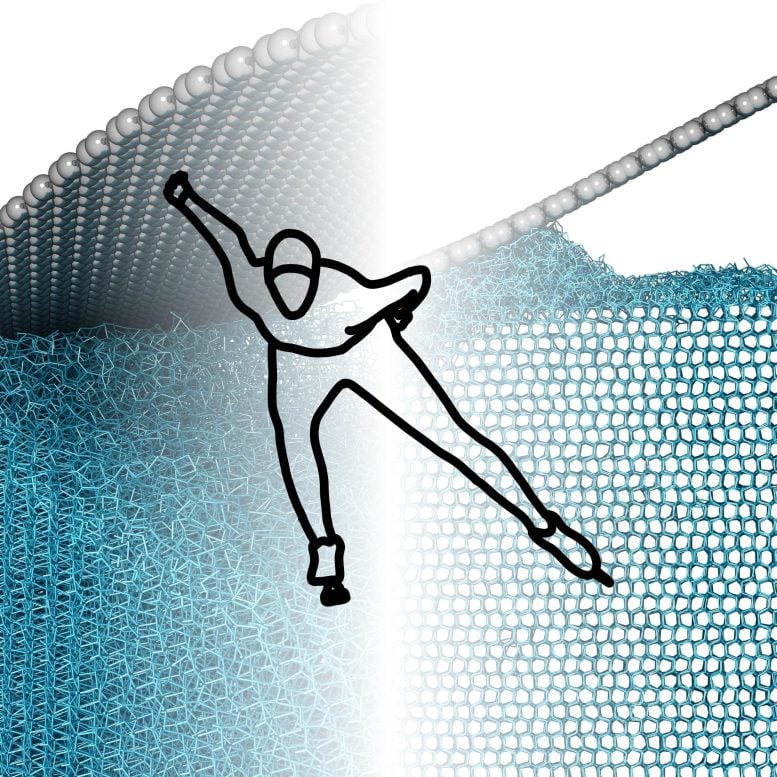
When someone climbs on this ordered structure, it is not the resulting pressure or friction that disturbs the upper layer of the molecules, but the orientation of dipoles in the interacting shoe sole with those of ice. The previously well -ordered structure suddenly becomes disorderly.
“In three dimensions, these Dipol-Dipole interactions become” frustrated “,” explains Müser, referring to a concept in physics where competing forces prevent a system from obtaining a completely ordered stable configuration.
At the microscopic level, the forces between the dipoles in the ice and those of the material of the shoe sole disturb the crystalline structure ordered at the interface between the ice and the shoe, which means that the ice becomes disorderly, amorphous and ultimately liquid.
Rethinking cold weather physics
In addition to overthrowing almost 200 years of accepted knowledge, the research of the team also demystified another false idea. “Until now, it was assumed that the ski below –40 ° C is impossible because it is simply too cold for a thin liquid film thin to form under the skis. This too, it turns out that, is incorrect,” explains Professor Müser.
“Dipolar interactions persist at extremely low temperatures. Remarkably, a liquid film is always formed at the interface between ice and skiing, even near absolute zeroSaid Müser. However, at low temperatures, the film is more viscous than honey. We barely recognize it as water, and skiing would be practically impossible – but the film nevertheless exists.
For someone who was breastfeeding an injury because he slipped and fell in winter, it does not matter that the pressure, the money, the N or the dipoles were not to blame. But for physics, the distinction is crucial. The implications of this discovery by the Saarland research team still take place, and the scientific community takes note.
Reference: “cold self-lubrication of sliding ice” by Achraf Atila, Sergey V. Sukhomlinov and Martin H. Müser, August 7, 2025, Physical examination letters.
Two: 10.1103 / 1PLJ-7P4Z
Never miss a breakthrough: join the Scitechdaily newsletter.


:max_bytes(150000):strip_icc()/Health-GettyImages-FoodsThatReduceCortisol-9997afbe6ac44384aaa8847d669c0608.jpg?w=390&resize=390,220&ssl=1 "8 foods that can help reduce your cortisol levels and make you feel calmer")