Warning: SPOILERS lie ahead for Bugonia!The Emma Stone-led Bugonia took some big swings when it came to bringing a new take to its South Korean source film, but its ending was one thing writer Will Tracy didn’t want to change. A remake of Jang Joon-hwan’s Save the Green Planet, the darkly comedic sci-fi film revolves around a paranoid conspiracy theorist who kidnaps a pharmaceutical CEO out of the belief she’s an alien, whose species intend to destroy the Earth.
Across its 118-minute runtime, there are a few notable changes from the original film, including gender-swapping both the CEO character with Emma Stone and kidnap partner with Aidan Delbis, and some of the build-up to the final act. One thing that stayed the same, however, is Bugonia‘s ending, in which Stone’s Michelle is confirmed to be an alien and, deeming humanity to be a failed experiment for her race, instantly kills them all while leaving the planet intact for the wildlife.
Helmed by five-time Oscar nominee Yorgos Lanthimos, who took over for Jang after he departed due to health concerns, Bugonia scored highly with critics beginning with its Venice International Film Festival debut, securing an 87% approval rating on Rotten Tomatoes. It’s also garnered plenty of buzz going into the awards season, with Stone and Jesse Plemons being eyed for Best Actress and Best Actor nods, as well as Lanthimos for Best Director and Tracy for Best Adapted Screenplay.
In honor of the movie’s streaming premiere on December 26, ScreenRant‘s Tatiana Hullender interviewed Will Tracy to discuss Bugonia. When asked about his approach to the movie’s ending, particularly whether he considered changing the alien reveal, the six-time Emmy winner did admit to considering having changed the epic final twist, but found that in staying true to Jang’s original, “it feels more like the clever, twisty ending to me“:
The more perhaps annoyingly clever ending would be, “Oh, turns out she was just really clever, and it was all in his head.” We could have done that, and it could have been an interesting ending that maybe could have said something about our politics or the way we relate to each other.
In staying with the shocking final reveal of Bugonia‘s source film, Tracy felt that he was able “to pull out a bit in those last few moments and widen the scope” of the themes and narrative he could explore. Acknowledging that it “sounds smart” to have considered two versions of the ending, one confirming that the conspiracies of Jesse Plemons’ Teddy were incorrect and the other with Michelle as an alien, the screenwriter felt that “it’s a pretty big swing“ that if it had been “in the hands of a lesser director or a lesser cast, we would’ve been in trouble.”
As to the overall feeling of Bugonia‘s ending, Tracy agrees that “one could interpret the ending as bleak,” he feels that’s a descriptor better saved for “a movie that purports to show you how the world really is” and leaves one feeling “there’s nothing we can do about it.” Instead, he feels there’s “so much possibility in the very open-ended final scene” of the film and the way it depicts the Earth in the wake of humanity’s demise:
What we see in the last few minutes of this movie has not happened, and it allows us to look at a world without us in it while also getting to see a little panoply of the human experience and everything that makes us weird and interesting and funny and occasionally awful and occasionally wonderful. We realize what would be missing without us for good and for ill. And there’s something constructive about that. It’s asking, “What do we want? How do we want to relate to each other? How do we want to relate to the planet that we live on?”
1 Key Change Unlocked The Rest Of Bugonia’s Script For Tracy
ScreenRant: With Bugonia being an adaptation, what was your most exciting challenge in translating this story to an American audience over 20 years after the original Korean film was released?
Will Tracy: I hadn’t seen the film or even heard of it, so I think what attracted me was the same thing that attracted Ari Aster, who produced the film. He suggested Save the Green Planet to me as something I might want to check out, I think because he knew my work from Succession and The Menu and felt that I’d find something in the movie that he also saw. Essentially, you could take the premise of the original film and make something entirely new that was grappling with contemporary American politics and culture, though I have subsequently begun to think of it as more of a global problem of disassociation from reality. There’s a bit of that in the original film, but that film is from 2003, and it’s very Korean in its attitudes and its preoccupations, so I just felt that there was something new to be explored there. I wanted more of a conversational chamber piece, structured on these long chats in rooms between people, with escalating tensions and revelations about emotional agendas.
ScreenRant: One somewhat superficial change with ripple effects is that there are not just one but two gender swaps. Can you talk about the origin of that change and how you felt it affected the story?
Will Tracy: Yeah, the first change was making the captive a woman. And I have to be honest, sometimes it’s just a thing that writers do where you have a pancake and are like, “Well, let’s flip over and see what’s on the other side.” I just changed the word “man” to the word “woman” in the script and see what comes out of it without really any intentionality, or I should say any forethought, intellectualizing why I was making that choice. I just tried to write the scenes that way, and it did seem to open things up immediately. I think when you have a story of young men kidnapping a young woman and holding her captive in the basement, the danger or the threat becomes quite different. You can play with that in interesting ways. I disrupted things at the very beginning of the script by having the young men chemically castrate themselves, but it still presents a number of interesting political, sexual, and emotional components that wouldn’t be there otherwise. I quite liked the idea of this very powerful woman CEO, who’s quite aware of the optics of being a powerful, ostensibly progressive female CEO and knows how to weaponize that. That seemed like an interesting element to add to those verbal confrontations they have in the basement.
Aidan Delbis as Don looking intensely toward the camera in Bugonia
And then, in terms of the character of Don [who was originally the male lead’s girlfriend], I don’t know why exactly I made that change either. I think I had a baseline in my head of thinking that the cousins could be like Al Pacino and John Cazale in Dog Day Afternoon and have that sort of dynamic. As I started to write the characters more, I was moved by the way that they were thrown together and how they were each other’s best and only friends. One of the cousins, Will, has this great passion and tyranny as he’s trying to save the planet. And the other cousin, Don, is not so much trying to save the planet as he is trying to save his cousin from himself. I started to write the Don character as the emotional intelligence of the movie, who sees what some of the other characters can’t see about themselves and about the situation that they’re in. I also started to write, without ever being explicit or specific about it in the script, that there was something neurodivergent about the character — but I wasn’t specific about it. And then, of course, our amazing casting director Jennifer Venditti found Aidan Delbis, who was a first-time actor and had never acted in a film before. Aidan identifies as autistic, and he just had this wonderful magnetic quality where he can be in a basement with two of the finest actors of their generation without ever once feeling out of place. Every time the camera lands on him, you’re quite drawn to him and quite happy to be on his face, hearing him speak. I did a little bit of work on his character, but not much. I wasn’t specific about anything in the script, so I wasn’t changing the emotional core of his character at all. I probably simplified his dialogue a bit to make it more straightforward and more in Aidan’s cadence, but that had more to do with him being a first-time actor. You try to make it as smooth as possible so that they can appear as natural as possible on screen and not put too many obstacles in their way.
ScreenRant: The film stays pretty grounded until Michelle discovers all the experiments, at which point we turn it up to 11. Were there changes made to that scene and Emma’s monologue from the initial draft, or did it evolve once Yorgos got it up on its feet?
Will Tracy: You can even hear a ratchet-up music cue, yeah. From what I remember of the original film, which I’ve only seen once, they filmed a bunch of montage moments and showed all these clips and things from the alternate history of our planet. I just didn’t write it that way and instead wrote it as a straight monologue. I think at first, Yorgos and I did have some conversations about that. It’s just her talking to him in the room to deliver this monologue, so what’s the best way to dramatize that? We didn’t really want to do clips. Is there some other way that she can physically embody this speech? But in the end, we ignored that. We went away from that and just did it how it was scripted, really. I think that is a testament to the actor delivering the monologue. Emma Stone doesn’t need anything, really. She doesn’t need any props. She doesn’t need any clips. She can completely own that space and inhabit everything that’s embedded within that monologue, and she can make the information in that monologue quite coherent to the audience. She’s able to do that with her power and her clarity. It just ended up being as simple as that, but I really enjoy the scene a lot. It does seem to take off into a different kind of reality, or unreality, until the rug is pulled out from under the audience again when she gets to the office. Suddenly, we’re pulling out a calculator and going into a closet, and all of a sudden it starts to feel like, “Oh, maybe that was all bulls–t.” It’s fun to play with those expectations.
ScreenRant: You mentioned some of the titles in your prolific career, but what is next for you after Bugonia? Are you looking to stay within your wheelhouse or branch out even more?
Will Tracy: I’d love to do something that’s quite different from anything I’ve done before. In my mind, The Menu, Succession, and other things like that all feel completely different. Succession’s a show about family, The Menu’s about art and food and ego, and Bugonia is more about cultural division and conspiracy or disassociation from reality. And yet, when I think about how other people look at them, there are obvious commonalities between them. They all contain stories about power and tend to be a bit political and relevant thematically. I know I’d love to do something that’s completely outside of that, but we’ll see. There’s nothing imminent to announce right now, but I have a number of scripts in development with different directors, and a script I’d like to direct myself soon as well.
ScreenRant: On the directing front, how do you expect that to shift your approach to the work?
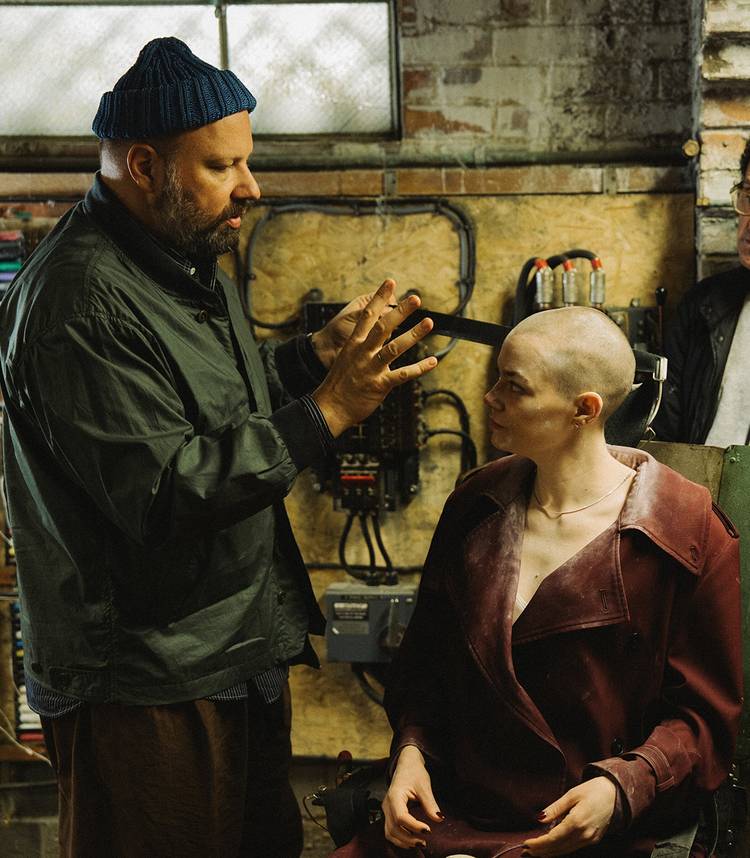
Yorgos Lanthimos talking with Emma Stone on the Bugonia set
Will Tracy: That’s part of why I like to be on set, and it’s why I was on set for much of Bugonia. I told Yorgos I wanted to watch him work, and I do like the way he works. He’s built a little traveling circus and a kind of surrogate family, since he often works with the same people. It’s a very relaxed atmosphere with no a—oles. Everyone’s quite lovely and quite familiar with each other, and it’s a really good feeling. And he shoots on film, which I would like to do. You pick up things from every director you see working, so that’s my plan.
ScreenRant: Throughout the movie, we also get these black-and-white flashbacks, which are a really nice touch that help humanize Will’s story.
Will Tracy: That’s right. They’re very Yorgos-ian, though they’re in my script, and it’s all the same dialogue, but I think Yorgos added to them. I knew we had to have something like those flashbacks because there’s just a lot of information about the relationship between Teddy and his mom and what happened to her, which he doesn’t really want to get into, and then how Michelle fits into that and how she figures that out. That’s just a lot within the way that our movie is structured. It was going to be hard to get that exposition in, so I knew I had to have something like that. But when I even say the word exposition, I get nervous. I’m a little bit allergic to that kind of thing, so what he did with those so-called flashbacks is to make them not very literal. As flashbacks, they are quite abstract, and you’re not really sure what’s going on. Is this how he remembers it? Are we seeing his vision of it? It’s not like we are cutting to him looking at a window, being reflective, and then we see the flashback before cutting back to him thinking at the window. It’s not presented like that at all. It’s more like the movie’s abstract dream of what might’ve happened, and that felt right. It felt good somehow and, emotionally, I think it gets at his trauma.
Be sure to dive into some of our other Bugonia coverage with:
Bugonia begins streaming on Peacock on December 26!
Release Date
November 7, 2025
Runtime
119 minutes
Director
Yorgos Lanthimos
Writers
Will Tracy
Producers
Andrew Lowe, Ari Aster, Ed Guiney, Emma Stone, Jerry Kyoungboum Ko, Lars Knudsen, Miky Lee, Yorgos Lanthimos, Kasia Malipan, Will Greenfield