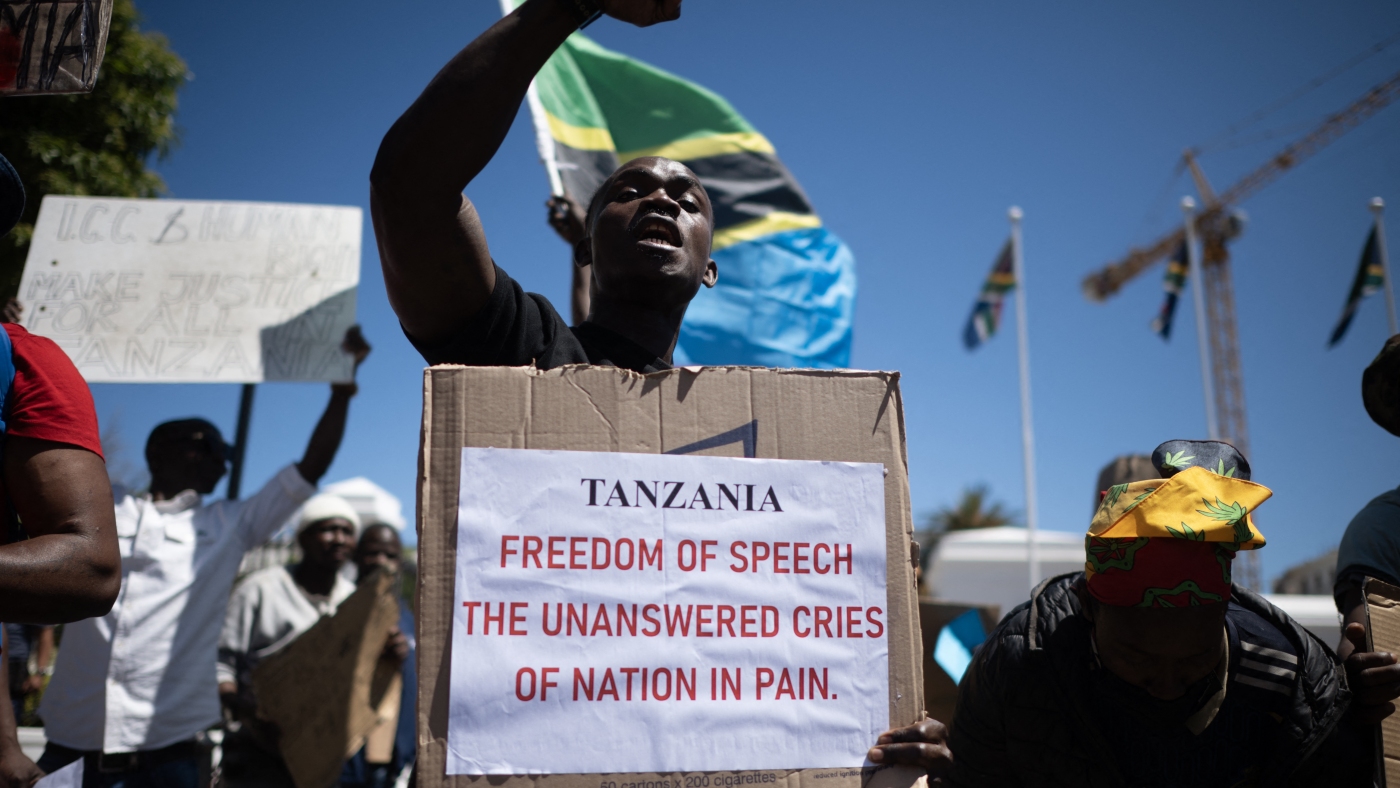
A protester holds a sign during a picket line in Cape Town, South Africa, to protest against the Tanzanian government in the October 2025 presidential election.
RODGER BOSCH/AFP via Getty Images
hide caption
toggle caption
RODGER BOSCH/AFP via Getty Images
NAIROBI, KENYA — The United States is “globally reviewing” its ties with Tanzania after the State Department condemned “repression” and “disturbing violence against civilians” during protests following the country’s disputed October presidential election, which returned President Samia Suluhu Hassan to power.
Officials said the government’s actions raise serious concerns about bilateral relations and the reliability of East African countries as partners.
According to the country’s main opposition party, the The United Nations and several rights groups, hundreds of people may have been killed following the government’s crackdown on protesters, although the government has not released an official toll and independent verification remains limited.
This is the most severe reproach launched by Washington against Tanzania and which last month saw the European Union suspend tens of millions of dollars in aid, citing repression and lack of transparency.
It comes just days after Tanzanian President Samia Suluhu Hassan angrily lashed out at Western nations, religious leaders and opposition figures, accusing them of interference in the country’s internal affairs.
“Do they still think that they are still our masters, our colonizers? Why, because of the little money they give us?” she told a gathering of alumni in the commercial capital Dar es Salaam.
Hassan described the deadly violence as an attempted coup and defended security forces accused of killing hundreds of protesters.
“Were these really protests or acts of violence? People were destroying government buildings, raiding police stations and stealing weapons. The police have a mandate to protect lives and property. When people say they used excessive force, what were they supposed to do, just sit back and watch a coup happen?” she told the applauding crowd.
Hassan claimed to have won 98% of the vote in the October 29 election, even though the main opposition parties were unable to participate and several of their leaders were arrested on treason charges.

A portrait of Tanzanian President Samia Suluhu Hassan during the October 2025 election campaign.
MARCO LONGARI/AFP via Getty Images
hide caption
toggle caption
MARCO LONGARI/AFP via Getty Images
Hassan became president in 2021 following the sudden death of President John Magufuli and initially positioned herself as a reformer. But critics say it continued and intensified the previous regime’s repression of dissent.
Opposition leaders deny any plot against the state and say government repression has killed more than 2,000 protesters. Dozens of people were arrested, opposition offices raided and prominent organizers forced into hiding. Hundreds of protesters are still missing and feared dead.
Among those killed was John Oduor, a Kenyan teacher shot dead in Dar es Salaam on polling day. More than a month later, his body is still in a Tanzanian morgue and his family has still not been able to repatriate him for a traditional burial.
“I appeal to the president of this great nation, my country, Kenya: please come and help us,” Oduor’s older sister Celestine told NPR. “We need closure as a family. We are tortured, emotionally and psychologically.”
Before the demonstrations planned for December 9, UN human rights experts condemned widespread violations in Tanzania, including alleged extrajudicial killings, enforced disappearances and mass detentions of protesters, opposition figures and civil society.
“The government must provide information on the fate and whereabouts of all missing people,” the experts said. “All restrictions on media coverage must be lifted, as they are inconsistent with Tanzania’s international obligations.”
International amnesty and other right-wing groups say Tanzania’s post-election crisis marks a deepening crisis in the region, with crackdowns on opposition and press freedoms across East Africa
For the Oduor family and hundreds of others searching for their loved ones, political rhetoric offers little comfort. “Each day without answers,” Celestine told NPR, “is harder than the last.”


