
Spoilers follow.
“Tron: Ares” may be the second sequel to the original groundbreaking 1982 sci-fi film, starring Jeff Bridges as a man sucked into the digital world of computers, but it does little to follow up on the events of the first sequel, 2010’s “Tron: Legacy.” The open-ended conclusion to “Legacy” is only briefly hinted at, including an ending that sets up another sequel in the “Tron” franchise, which should “Ares” perform quite well at the box office. Instead, “Tron: Ares” feels more like a direct sequel to “Tron,” even if it keeps the “Tron: Legacy” canon intact. That’s largely because we’re once again dealing with an evil Dillinger, and the end credits scene brings his legacy back to the beginning of the franchise.
In the original “Tron,” the antagonist is Ed Dillinger (David Warner), senior executive vice president of technology company ENCOM. Dillinger rose to the top of ENCOM’s ranks by plagiarizing video game ideas from tech genius Kevin Flynn (Jeff Bridges), and Flynn is trying to hack ENCOM’s systems to prove it with a program called CLU. However, Dillinger implemented a Master Control Program (MCP) to stop outside hackers.
When the MCP destroys the CLU, Flynn and a few of his colleagues plan to use a program called Tron to counter the MCP’s efforts and obtain the information they need. But before they can do so, the MCP activates an experimental particle laser that scans Flynn into the ENCOM computer grid, where computer programs are living entities that resemble the image of the human users who created them. That’s why when Flynn meets the MCP’s second-in-command, named Sark, he’s a character who looks like David Warner, just in a shiny orange computer circuit board style suit.
It’s this detail that comes into play in a major way in the credits scene of “Tron: Ares”, hinting at a central story thread that will bring Ed Dillinger’s legacy full circle.
Setting up the Tron: Ares mid-credits scene
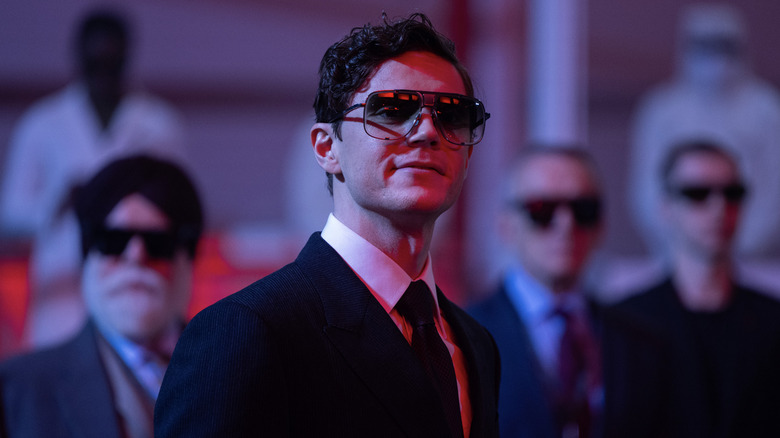
In “Tron: Ares”, Julian Dillinger (Evan Peters) – grandson of Ed Dillinger and son of Edward’s heiress and successor, Elisabeth Dillinger (Gillian Anderson) – is the head of Dillinger Corporation, a direct competitor to ENCOM, which is now led by Eve Kim (Greta Lee). Both are attempting to achieve a breakthrough in new technologies that would enable the creation of artificially intelligent humanized programs like Ares (Jared Leto, star of the much-maligned “Morbius”) and Athena (Jodie Turner-Smith), designed as expendable, duplicable soldiers to carry out Dillinger’s orders, as well as sleek and stylish advanced vehicles like the lightcycles, all brought into the real world from the virtual computer world known as “Lightcycles”. grid. The only problem is that they can’t make their laser-printed creations survive in the real world for more than 29 minutes. ENCOM and Dillinger are therefore both seeking a permanence code to end this gap.
The entire film is a race to find the permanence code, which is believed to be located somewhere in Flynn’s old files. This provides plenty of neon-infused action to keep the film exciting, as light cycles race through the real world, cutting police cars in two and creating chaos in the streets. But Julian goes too far in his quest for the code of permanence, even going so far as to approve the execution of Eve Kim after scanning her with a new particle laser gun and sending it into the grid.
After Ares learns more about Eve, he defies Dillinger’s orders and chooses to help Eve find the Permanence Code, not only to prevent herself from dying over and over again, but also to help Eve use technology to improve the real world. So Dillinger sends Athena after Eve and the malware, giving her permission to stop them by any means necessary.
Ultimately, Ares overcomes his original programming and helps recover the Permanence Code, which essentially turns him back into a human, and Dillinger must deal with the fallout from all the destruction he caused by unleashing Athena and a massive Recognizer ship on the city.
What does the end credits scene of Tron: Ares mean?
However, instead of facing the consequences when law enforcement arrives at Dillinger Industries, he reprograms the machine that created Ares, Athena, and their various weapons and vehicles from the Grid, and he uses it to scan himself into the Grid. Unfortunately, Dillinger analyzes himself in a destroyed landscape that was once occupied by the Dillinger Industries server, which was brought to ruin by a real-life hack at ENCOM in order to prevent other soldiers like Athena from entering the real world. But there is a secret waiting in the shattered tower where Ares once stood.
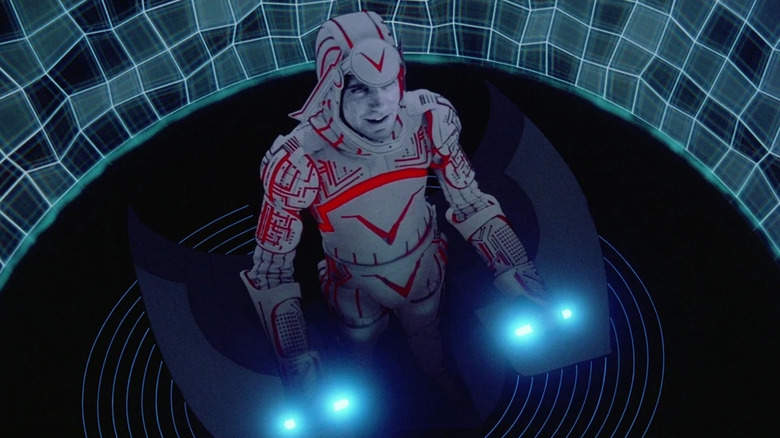
After Julian gazes upon the destroyed digital landscape, a small sign rises from the floor of the tower. Inside the panel is a glowing orange light disk. But it’s not the kind of glowing disk we saw in “Tron: Legacy” or even the new triangular disks in “Tron: Ares.” This is one of the classic light discs from the original “Tron”.
When Julian reaches out to touch the disc, a holographic overlay suddenly envelops his body as he screams in agony. As the holograph takes shape, we see that it is the exact same type of suit and helmet worn by Sark in the original “Tron.” Within the Grid, Dillinger has come full circle with his grandfather’s legacy, and he’s ready to become an even more dangerous foe in a potential “Tron 4.”
As for plans for how this development could play out in a new film, the film’s screenwriter Jesse Wigutow sees a lot of potential, but one thing has to happen. As he told our own BJ Colangelo in an interview before the film’s release, “The lords above must feel like there’s more to be had at the corporate level. From a storytelling standpoint, I think there’s an awful lot left on the table to work with, and it would be a lot of fun to get back to that.”
Here’s hoping enough people come out for “Tron: Ares” so we can see a fourth film in the franchise.


