
3D printers have come a long way since the days of producing flimsy plastic lamps and cheap toys. More than 40 years after the first 3D printed object, advanced machines are now capable of creating biodegradable kitchen utensils, artificial animal skin and even entire ready-made houses built from dirt. Now, two college graduates have teamed up to pursue an even more ambitious goal: printing water from nothing.
Louisa Graupe and Julika Schwarz, graduates of the FH Münster University of Applied Sciences, designed a prototype 3D printed device, aptly named Water from Air. They claim the device can produce up to 1.6 gallons of drinking water per day using only air. Made primarily from 3D printed materials, the device extracts moisture from the atmosphere, traps water molecules, then condenses them into drinkable water. Built-in “metal-organic frameworks” remove most air pollutants, potentially eliminating the need to pass water through an additional filter. A built-in spigot at the bottom of the device allows collected water to be poured directly into a tumbler or other storage container.
Although work is still ongoing, engineers believe the device could provide a smaller, more practical solution for individual households facing water shortages. Writing on design site Behance, they describe Water from Air as “a mobile water production and storage unit that can be used flexibly in private households, regardless of geographic and social circumstances.” They describe the device as a “practical solution and potential application option for people around the world.”
Water from the air could produce enough water daily for a family of four
In its current version, the device has several stackable sections, each produced using a 3D printer. The top, which resembles a French press, opens to suck water molecules from the air. After about an hour, the flap closes and the device begins to heat up, triggering the condensation process. Engineers say the integrated materials eliminate most, if not all, harmful air pollutants. The condensed water then drips into a base at the bottom.

A complete cycle takes about two hours and produces 17 fluid ounces (about the equivalent of a medium-sized plastic water bottle). If operated continuously for an entire day, the device could produce about 1.6 gallons of drinking water, which engineers say is enough to support a family of four, assuming each person consumes 1.5 liters of water per day.
It should be noted that the device, as intriguing as it may seem, is not ready for large-scale use. In response to comments on Behance, Schwarz clarified that the materials used in the device are still being researched and the patent process is ongoing. The engineers did not mention any price.
“Our goal was to illustrate the potential of this new material through user-friendly, self-contained product design, something that previously only existed in complex laboratory setups,” writes Schwarz.
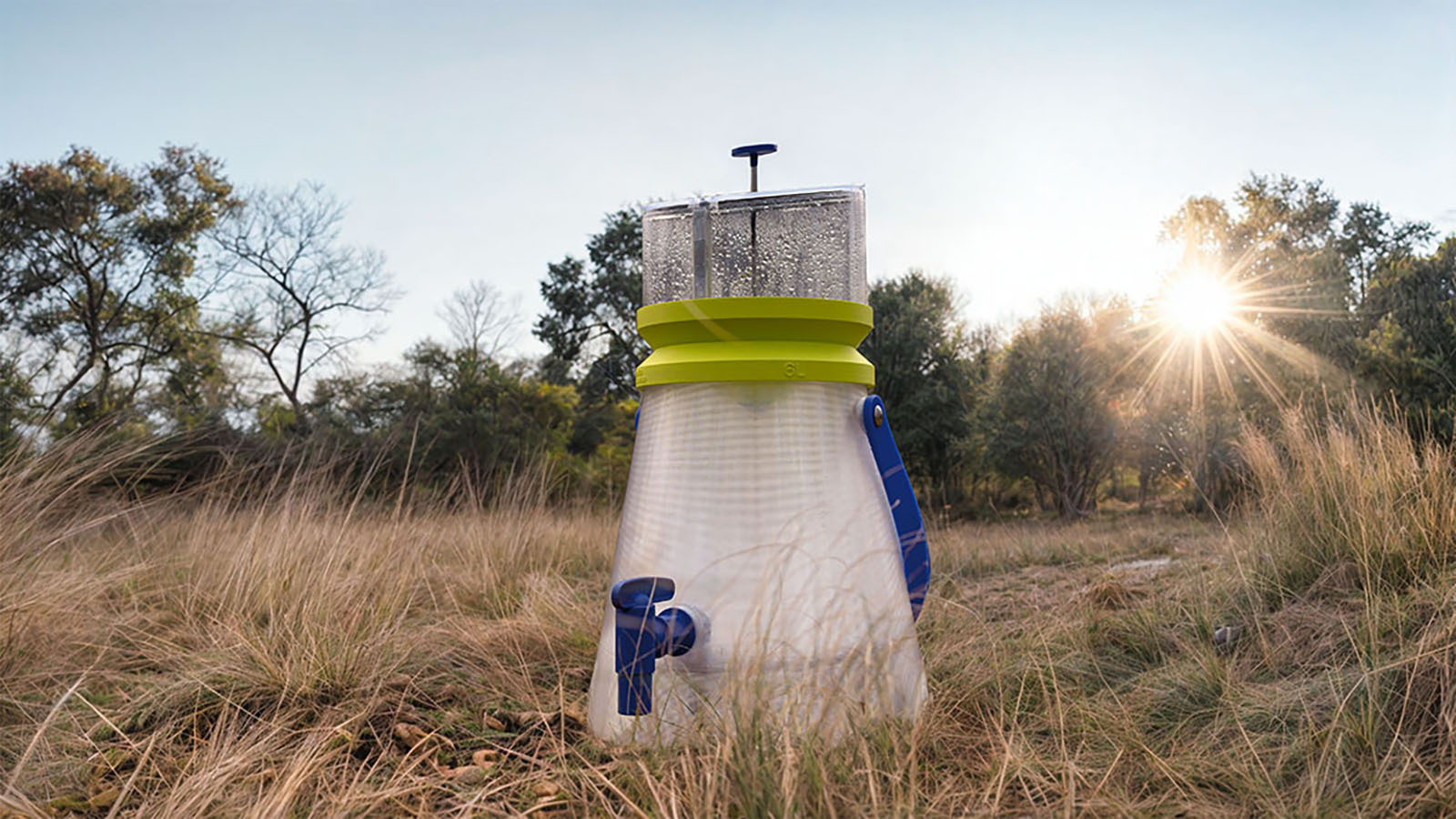
A portable solution to tackle the world’s growing water shortage
The engineers say they were motivated to pursue the project after becoming aware of the growing problem of water insecurity around the world. In the United States, the Centers for Disease Control and Prevention estimates that about 2.2 million people live in homes without plumbing or running water. A recent paper by researchers at Arizona State University estimates that up to 12 percent of U.S. residents could face water insecurity. These effects are disproportionately felt by Latino, Black, and Indigenous communities across the country.
This is remarkable, but the problem becomes more evident when you zoom out on a global scale. The World Economic Forum estimates that approximately 72% of the world’s population experiences some form of water insecurity. About 8 percent of the world’s population falls into the most extreme category of those facing “critical water insecurity.”
Current approaches to addressing water insecurity often rely on large, expensive, and technically complex water conversion systems. Engineers note that these systems are not always well suited to the varying and individual needs of households. In theory at least, a household could use a Water from Air device during the day to collect the amount of water they need. The 3D printing element also offers another benefit: because design files are stored digitally, communities around the world can print their own devices locally, eliminating the need for a centralized distribution system.
“The basic idea of getting water for air has great potential for the future, as the need for clean water sources increases,” Graupe and Schwarz write on Behance. “It is also possible in larger scenarios… to supply water to entire communities. »

Shop Amazon’s Prime Day Sale


