
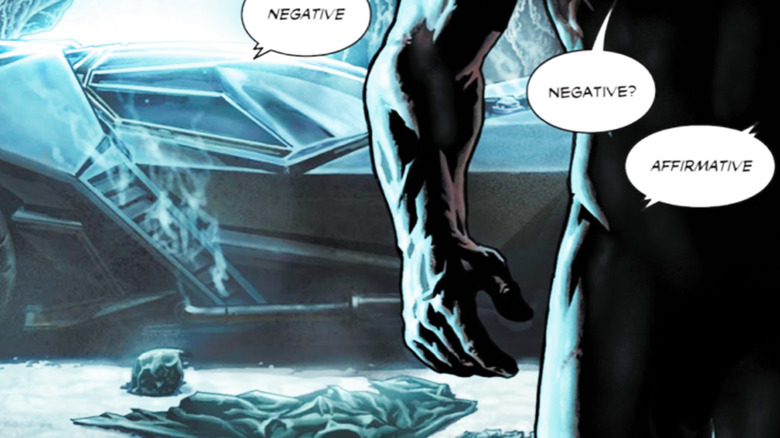
Comic book collectors all have their holy grail, whether it’s a first appearance, a low-run issue, or a rare variant cover. Some, however, want to see Batman’s nether regions and will pay a high price for the privilege. This was the case with 2018’s “Batman: Damned,” which contained an explicit panel that was censored after the initial print run, ensuring an increase in the value of these original books.
In 2018, DC Comics did what Warner Bros. should have done it a long time ago. The company created DC Black Label, an imprint where it could release more mature standalone stories showcasing creators’ unique artistic visions without having to worry about in-universe continuity. If Warners had done this with their big-screen DC adaptations rather than trying to emulate the Marvel Cinematic Universe model, we might well have avoided box office disasters of superheroic proportions like 2022’s “The Flash.” DC Black Label, meanwhile, was birthing inventive, fresh takes on classic characters long before “Absolute Batman” made major changes to Bruce Wayne’s story – notably with the first title published under the brand: “Batman: Damned”.
Released in September 2018, this three-issue limited series came from writer Brian Azzarello and artist Lee Bermejo, whose grimy yet beautiful art was perfect for Black Label’s inaugural release. Besides a good story and immersive art style, “Batman: Damned” was also a very satisfying item to own, with a glossy cover in a prestigious format that felt very premium. With all of this in mind, the book didn’t necessarily need much else to make it a desirable release. But when it was first published, it also came with full-frontal nudity of Bruce Wayne, prompting DC to censor future printings and skyrocket resale prices.
DC quickly censored Batman: Damned
When DC Black Label was announced in March 2018, it was billed as a creative haven where writers and artists could tell their stories unhindered by the larger canon. In a press release, publisher and future DC creative director Jim Lee said the imprint “doubles down on our commitment to working with and trusting top-notch talent to tell epic, moving stories that only they can tell with the highest levels of creative freedom.” However, when “Batman: Damned” arrived in September, that commitment to creative freedom was immediately called into question.
“Damned” is one of the best Batman comics of recent years, telling a supernatural horror story in which the Joker’s body is discovered on a Gotham City bridge, sparking an investigation that sees the Dark Knight venture into the supernatural recesses of his hometown. The book caused something of a sensation when it debuted, not because of its immersive, dark depiction of Gotham or its immaculate art, but because in one panel, Bruce Wayne is seen in the Batcave walking away from his Batmobile, having discarded his clothes. Barely noticeable in the darkness is the hint of a penis, which was apparently enough to send everyone, including DC’s executives, into meltdown.
DC quickly announced that it would censor all reprints and digital copies, but the first run included 115,000 uncensored copies, so the cat was already out of the bag, or rather, the troopers were truly out of the pants. At the time, The Hollywood Reporter cited a “source close to the project” as saying that DC had decided that nudity “didn’t add anything to the story,” which is an odd decision to make after the long-delayed comic book release.
An original Batman: Damned is now a collector’s item
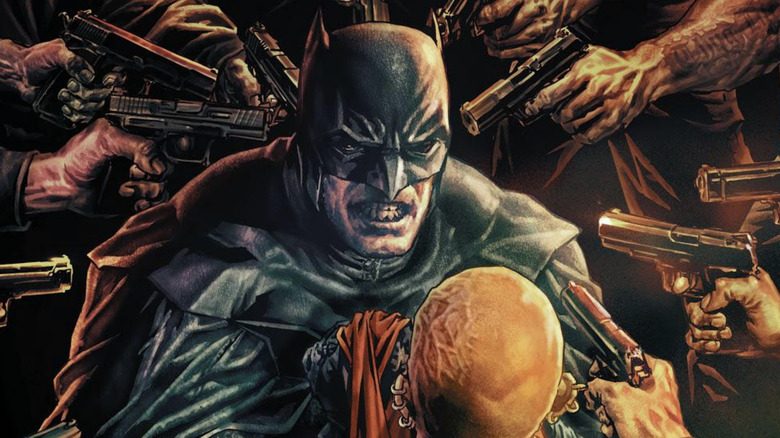
According to DC, the offending limb in “Batman: Damned” was the result of a production error, whereby the panel in question was lit, which simultaneously made Bruce Wayne’s private parts more visible. Regardless, at New York Comic Con 2018, Jim Lee said that the “Batman: Damned” controversy made DC comics “look at what Black Label is and wonder if those things add up to the story.” Co-editor Dan DiDio added: “This is something we wish would never happen because it really distracted from what we thought was quality storytelling.” This was all just confusing, as DC had arguably added to the controversy by censoring the reprints.
Naturally, the debacle meant that uncensored copies became sought-after items on the second-hand market. Early print runs initially reached the $100 mark and beyond – a considerable jump from the initial cover price of $6.99. Today, an original printing of “Batman: Damned” #1 costs anywhere from $50 to more than $100, less than 10 years after its original publication.
Four years after this whole fiasco, Lee Bermejo spoke to Popverse, saying he was surprised by the controversy. “I honestly thought that we had come so far in comics,” he said, “that we could treat something like Batman the same way we look at Greek or Roman statues… in other words, as art.” Bermejo, looking dejected, added that he learned that comic books “were never going to be high art” and that his miniseries “Damned” was “always a comic book about a guy in a stupid costume.” The artist nonetheless remains proud of the work he did on the book, noting how he and Brian Azzarello did something “a little risky with the story and the structure.” Too risky for DC Black Label, apparently.


