
President Donald Trump with Office of Management and Budget Director Russell Vought.
Credit: Brendan Smialowski/AFP via Getty Images
President Donald Trump with Office of Management and Budget Director Russell Vought.
Credit: Brendan Smialowski/AFP via Getty Images
However, it may be years before the full impact of the Trump administration’s shutdown and broader attacks on science on U.S. international competitiveness, economic security, and electoral politics materializes.
At the same time, dramatic declines in international student enrollment, financial challenges facing research institutions, and research security measures aimed at curbing foreign interference portend an uncertain future for American higher education.
While neither the White House nor Congress appear willing to reach a budget deal, Trump continues to test the limits of executive power, reinterpreting the law – or simply ignoring it.
Earlier in October, Trump redirected unspent research funds to pay out-of-work military members before they missed their Oct. 15 paychecks. The change in appropriations directly challenges the authority given to Congress – not the president – to control federal spending.
The White House’s promise to lay off an additional 10,000 civil servants during the shutdown, its threat to withhold back pay from furloughed workers, and its willingness to end any program whose funding is not used “inconsistent with the president’s priorities” also aims to expand presidential power.
Here, the damage to science could snowball. If Trump and Vought take away enough authority from Congress in making funding decisions or closing statutory agencies, the next three years will see an untold amount of research funds seized, canceled or reused.
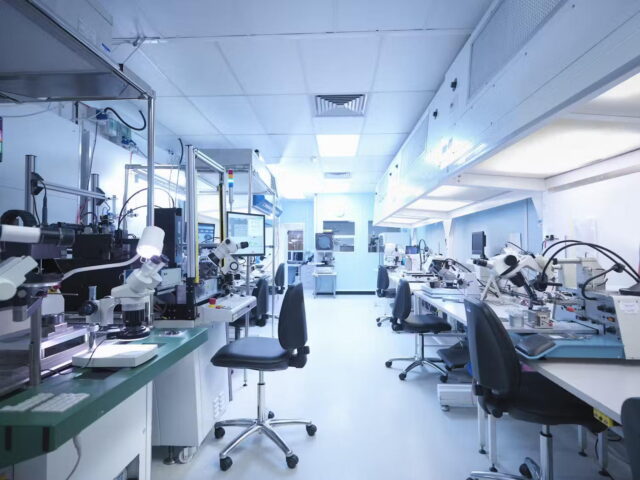
The government shutdown has emptied many labs staffed by federal scientists. Combined with other actions by the Trump administration, more scientists could continue to lose funding.
Credit: Monty Rakusen/DigitalVision via Getty Images
The government shutdown has emptied many labs staffed by federal scientists. Combined with other actions by the Trump administration, more scientists could continue to lose funding.
Credit: Monty Rakusen/DigitalVision via Getty Images
Science, democracy and global competition
While technology has long been a critical pillar of national and economic security, science has only recently re-emerged as a key driver of greater geopolitical and cultural change.
China’s extraordinary rise in science over the past three decades and its emergence as the United States’ main technological competitor have overturned the conventional wisdom that innovation can only thrive in liberal democracies.
White House efforts to centralize federal grantmaking, restrict free speech, erase public data and expand surveillance reflect China’s success in building scientific capacity while suppressing dissent.
As the Trump administration’s vision for American science becomes clearer, it remains unclear whether, after the shutdown, it will be able to compete with China by following its lead.
Kenneth M. Evans is a science, technology, and innovation policy fellow at the Baker Institute for Public Policy at Rice University.
This article is republished from The Conversation under a Creative Commons license. Read the original article.


