We may receive a commission on purchases made from links.
You won’t get many arguments from comic book fans that Batman has the best villains. Being obsessed with ranking, superhero fans always try to narrow it down even further to the best Batman villains – Arkham Asylum’s Mount Rushmore, if you will.
I’d say the Riddler deserves a place on Mount Arkham. Yes, he is one of the fanciest Batman villains (even his name, Edward Nigma/Nygma or E. Nigma) and may be one of the silliest. But the Riddler is also one of Batman’s most persistent villains, with genuine villainy beneath the showmanship. Answer one of his riddles incorrectly and it’s a death trap for you; the Riddler is practically the original puzzle. In “Batman: Dark Knight, Dark City”, with its horror flavor, Eddie even tries his hand at occult sacrifice.
Riddler is also one of the most recurring big-screen Batman villains, played by actors ranging from Frank Gorshin to Robert Englund (in the underrated 2004 cartoon “The Batman”) to Paul Dano. Yet while many would rank “Batman: The Animated Series” as the best iteration of Batman, there is surprisingly little Riddler. John Glover’s smooth vocal performance is perfect, but the Riddler was the main villain in only three episodes out of 85: “If You’re So Smart, Why Aren’t You Rich?”, “What Is Reality?” and “The Riddler’s Reformation.” When the series returned as “The New Batman Adventures”, the Riddler only received small cameos.
Riddle me this: why so little Riddler? In the behind-the-scenes book “Batman Animated,” writer/producer Paul Dini called the Riddler “a constant frustration to Batman as well as our writing team,” who had “the dubious honor of being the most difficult villain on our series.” It turned out that the Riddler’s gimmick didn’t lend itself well to writing stories for a half-hour action cartoon.
The Riddler made the stories too complicated for a half-hour cartoon
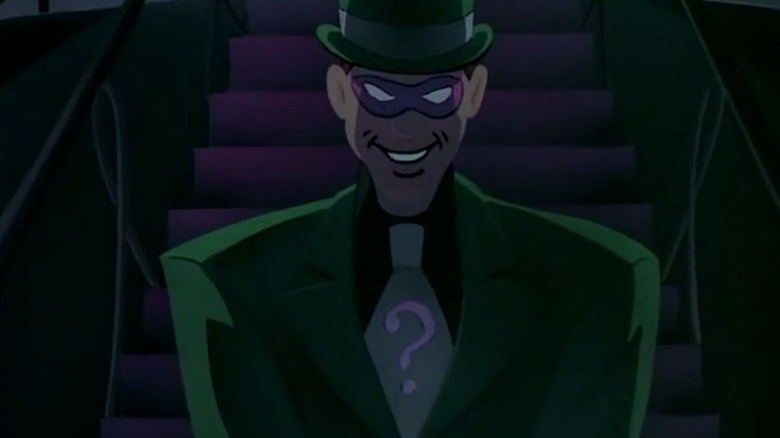
“[The Riddler] isn’t much of a physical threat and his reliance on riddles, games and puzzles brings him tantalizingly close to self-parody,” Dini wrote, explaining the first problem the “Batman” writers had with the Riddler. “Another drawback is that the Riddler is a verbal, cerebral character who seems to work better in the comics than in animation. In a comic book, detective story, or live-action drama, the writer has the luxury of time to set up and solve a mind-blowing crime. In a twenty-two minute cartoon, the action must continue. »
“Batman: The Animated Series” receives much deserved praise for its mature writing, but it was a children’s show that was supposed to keep these children hooked on the show. Indeed, note how the Riddler first took off as a villain in the Adam West television series “Batman,” which used a two-part, one-hour episode structure. This series had some wiggle room for Riddler stories, unlike “The Animated Series.”
To write a Riddler story, you also need to write mysteries, especially ones that are compelling as a challenge for a master detective like Batman. Write mediocre or simple puzzles, and Batman and Riddler seem incompetent. All of this amounted to, as Dini admitted, “at least half a dozen complete or partially completed Riddler stories in our dead script file that ultimately proved too complex or too stupid to produce.”
The Riddler episodes that were products, Dini said, were ones that focused first and foremost on the psychology of the Riddler. He is motivated not only by a compulsive desire to pose and solve puzzles, but also by a persecution complex and a vengeful and envious side. After all, fashion isn’t the only reason Riddler prefers Green clothes.
The Riddler, Reformed
In the Riddler’s first appearance, he is introduced as a computer programmer who created a successful video game, “Riddle of the Minotaur”. As payback, Nygma’s boss, Daniel Mockridge (Gary Frank), fires him to deprive him of profits. Nygma disguises himself as the Riddler to get revenge on Mockridge. In this episode, Riddler actually wins…sort of. By the time Batman and Robin rescue Mockridge from the Riddler’s Labyrinth, Eddie has fled Gotham.
The episode ends with Mockridge living in paranoia and thinking that the Riddler will return for another attempt at revenge. Batman poses the final riddle: “How much is a good night’s sleep worth”? If this had been the Riddler’s only appearance, it would have been an open, groveling ending, but the Riddler is simply too important a villain to use just once.
“What is reality?” draws on the video game motif of the Riddler’s first appearance; he traps Batman in a virtual reality simulation. This one is definitely the weakest of the three Riddler episodes in the series, the kind of fanciful story that makes you understand why the writers had trouble with the Riddler. “Riddler’s Reform” was much fresher. As the title suggests, Nygma was trying to build a new life for himself as an entertainment mogul. Batman wasn’t convinced, and in the end, the Riddler’s compulsiveness led him back to crime.
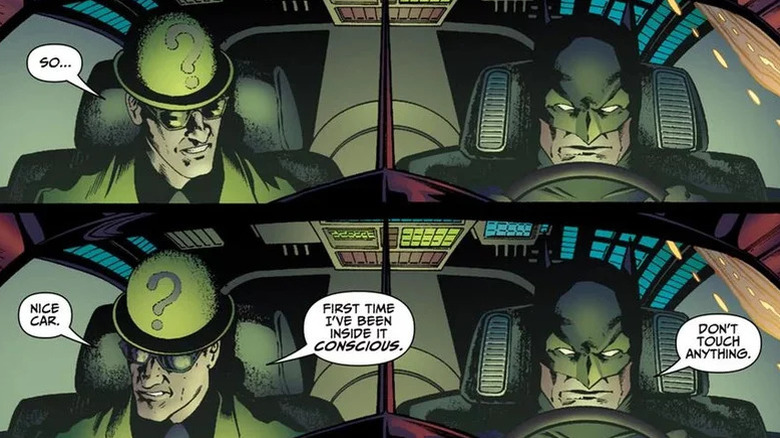
Dini (who co-wrote “Riddle’s Reform”) must have been attracted to the idea of a reformed Riddler. While Dini was writing “Detective Comics” in the 2000s, he reimagined the Riddler as a private investigator, who helps Batman and the Gotham Police Department with criminal cases. The Riddler’s new leaf didn’t stay turned over, but “E. Nigma, Consulting Detective” is definitely a creative solution to Dini’s problems with writing the Riddler’s plots.