Swing District Republican Sounds Alarm on GOP Affordability Agenda: ‘Doing Nothing Is Not an Option’


Rep. Brian Fitzpatrick, one of the few House Republicans to win in a district won last fall by then-Vice President Kamala Harris, has a tough message for his party as the deadline approaches to extend expiring health care subsidies and as the midterm elections approach.
“If you don’t have a better plan, then get on board with ours,” Fitzpatrick said. “But doing nothing is not an option.”
In a wide-ranging interview with CNN’s Manu Raju for “Inside Politics Sunday,” Fitzpatrick reflected on areas in which he broke sharply with his party’s leaders, including his desire to find a compromise on health care, his strong commitment to defending Ukraine and his past votes against advancing major elements of President Donald Trump’s agenda.
The Pennsylvania lawmaker is among a handful of House Republicans proposing legislation to extend enhanced Affordable Care Act subsidies set to expire at the end of the year.
Although he doesn’t agree with every part of former President Barack Obama’s health care law, Fitzpatrick has made clear that a short-term plan to protect Americans from skyrocketing insurance premiums is better than anything he’s seen from his party.
Fitzpatrick voted against the Republican Party’s push to repeal Obamacare in 2017 because he found the replacement “insufficient.”
Now, eight years later, he says Republicans “still can’t come up with an articulate plan that would work for ordinary Americans.”
Fitzpatrick suspects House Speaker Mike Johnson believes he represents the majority of his conference by promising to promote a new GOP health care plan instead of holding a vote to extend the ACA tax credits.
But the swing district Republican said even some of his most conservative colleagues have expressed interest in his efforts to reach a compromise on ACA subsidies.
“Affordability is a real crisis in this country right now,” he said, explaining that for low- and middle-income citizens, “significantly increasing their premiums is not an option.”
Fighting rising costs will be “the issue” in the 2026 elections, Fitzpatrick predicts. He pointed to Trump’s election to a second term and Democrat Zohran Mamdani’s recent victory for New York City mayor as examples of what happens when voters are motivated by cost-of-living concerns.
Although the president called affordability a “hoax” last week, as Democrats begin to focus on the message, Fitzpatrick disagrees: “Believe me. I hear this every day at home. It’s real. »
Asked if the Republican Party had focused enough on this issue, Fitzpatrick said, “I don’t think they have. »
“Every bill we introduce should be aimed at lowering the cost of living for the people who need it most,” he said, criticizing recent legislative efforts to condemn socialism and regulate compensation for college athletes.
“Why are we focusing on this? That’s not what our voters care about,” Fitzpatrick continued.
Republican frustration is increasingly directed at Johnson, as he fights to maintain his slim majority and retain the president’s support.
Asked if he thought Johnson could win the gavel again next term if Republicans retained control of the House, Fitzpatrick said, “I’m not sure Mike wants the job in the next Congress, but that’s a question for him.”
Fitzpatrick and Johnson entered Congress as classmates in 2017, when Fitzpatrick remembers his colleague “leading the bipartisan charge for civility.”
“Personally, I like him. Do I agree with every decision he makes? Absolutely not. I never agree with every decision every speaker makes,” he said, clarifying that his “personal frustration” with leadership comes from his desire to empower rank-and-file members to better serve their constituents.
“I think the best way to run the assembly is to allow each member to identify a district priority that is top of mind in their district and give the entire assembly a vote on it,” he explained.
One of the bills Fitzpatrick wants to see quickly in the House is a measure imposing heavy sanctions on Russia.
Fitzpatrick, who is co-chair of the Congressional Ukraine Caucus, introduced a bill mirroring Senators Lindsey Graham and Richard Blumenthal’s wildly popular bipartisan bill to impose crippling tariffs on countries that buy oil and gas from Russia.
While Fitzpatrick acknowledges that there are obstacles to getting a vote on his bill in the House, including concerns among otherwise empathetic Democrats about Congress granting the president new tariff authorizations, Fitzpatrick cautions, “I don’t want to let the perfect be the enemy of the good.” »
“What I think we need to do is make sure we send a signal to Russia, to Ukraine and to the world that Congress cares about Ukraine,” he said, noting the outpouring of bipartisan support for previous bills supporting the war-torn country.
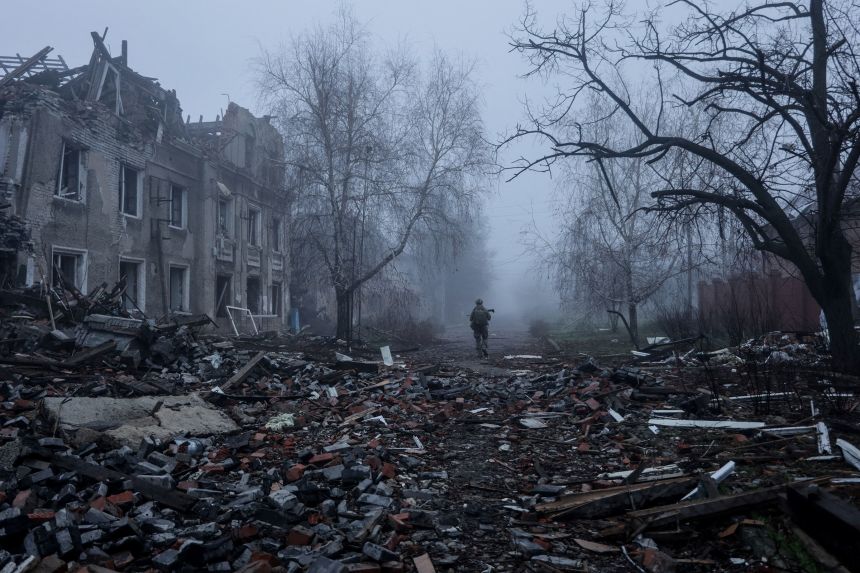
Fitzpatrick aligns himself with other Russia hawks at the conference who want “much more moral clarity from the administration,” taking a critical look at Trump’s relationship with Russian President Vladimir Putin.
“It doesn’t matter how successful you are as a businessman, the Russians are masters of the art of propaganda,” he said. Asked if Trump was being played by Putin, Fitzpatrick said, “He was too deferential to him,” adding, “To say someone is being ‘played’ is kind of insulting their negotiating tactics.”
As the Trump administration continues down the rocky path toward a peace deal in Ukraine, Fitzpatrick is recommending an aggressive approach toward Putin, whom Trump last met at a high-stakes summit in Alaska in August.
“We just need to be much more tactful towards it, because dictators understand one thing and one thing only,” he said. “Look what brought him to the table. It was the threat of sanctions, and it was the threat of Tomahawk missiles.”
Fitzpatrick has unequivocally declared that he will run for re-election, despite the steep climb Republicans will undertake to retain control of all the levers of power in Washington.
He is one of only three House Republicans who won in a district where Trump lost the 2024 election. Another of those lawmakers, Rep. Don Bacon of Nebraska, has already announced he will not seek re-election next year.
“I’ve lived in these environments before, but I’m very close to my district,” Fitzpatrick said.
The fifth-term congressman recalled 2018, when he was elected to a second term by less than 3 percentage points, amid backlash over Trump’s first two years in the White House and after a blow to Pennsylvania Republicans’ attempts to draw more favorable maps.
“It is natural that the pendulum always swings in politics,” he argued. “Angry people vote, happy people don’t. »
Still, Fitzpatrick dismissed the potential drag Trump could have on his race.
“I’m a pretty independent-minded person,” he said, emphasizing his willingness to break with his party on important votes, such as Republican leaders’ desire to pass Trump’s sweeping domestic policy agenda before the president’s self-imposed July 4 deadline.
“I’ve received a lot of criticism about this, both at home and from the White House and some of my colleagues here, but I politely reminded them that I don’t answer to anyone or any party in Washington, D.C. My bosses are back home,” he said.
Fitzpatrick believes Trump’s megabill, which the House passed earlier this year with all but two Republican votes, is out of step with what Americans want “on multiple fronts,” including cuts to Medicaid.
As for whether these cuts could cost Republicans the majority, Fitzpatrick said “everyone is going to answer for their votes,” pointing to the most popular tax cuts that have accompanied tightening access to Medicaid and other government programs.
“You have to have a strong backbone and a thick skin, and the easiest way to get through times like this is to never lose sight of who your bosses are,” he said.


