
Taylor thought there might be a way to test this new hypothesis, especially in light of numerous experimental studies showing the prevalence of fractals in human physiology: walking, dancing, martial arts, and balance movements, such as postural sway while standing. “Let’s think about this balancing mechanism,” he said. “You’re off balance, you’re swinging, so you have big swings mixed with smaller and smaller swings. It’s a multi-scale thing.”
Drip, drip, drip
Serendipitously, Taylor even had a built-in laboratory environment in which to conduct such experiments: the public “Dripfests” he regularly held, during which adults and children had the opportunity to create their own Pollock-style works of art by splashing diluted paint onto sheets of paper placed on the floor. Life changes occurred before Taylor could implement the experiment, and the concept took a back seat. But he relaunched it a few years ago.
The study subjects were 18 children aged four to six years old and 34 adults aged 18 to 25 years old. The age gap was crucial, as these two groups are at markedly different stages of biomechanical balance development. And this time around, Taylor and his co-authors didn’t just look at the fractal dimensions of the resulting paintings—that is, measuring the self-similar scaling behavior of the splatter patterns. They also looked at what’s called “gapness,” looking at variations in the gaps between paint clumps.
Image by Pollock Issue 14, 1948.
Fairbanks et al., 2025
Image by Pollock Issue 14, 1948.
Fairbanks et al., 2025
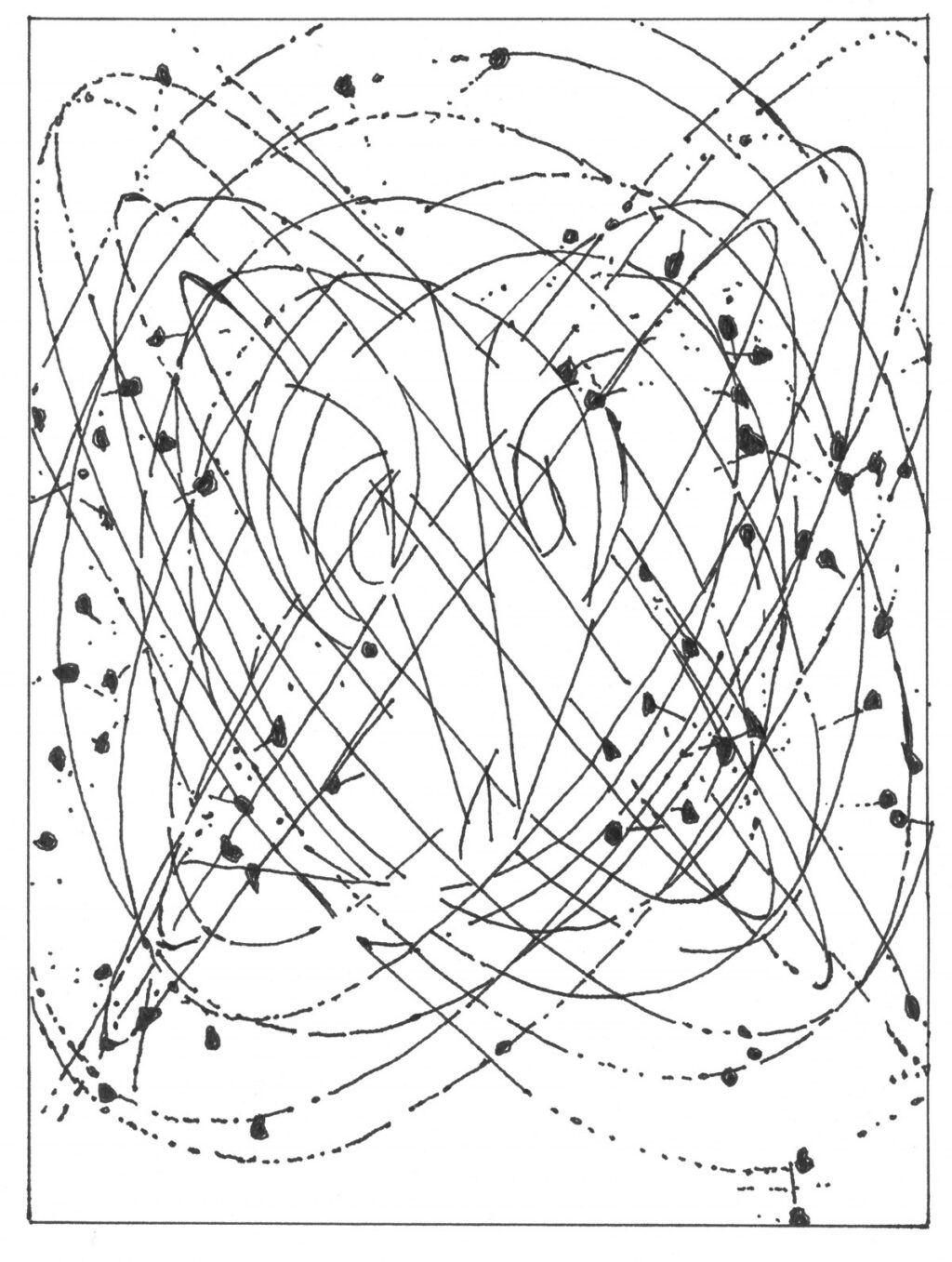
Image by Max Ernst Young man intrigued by the flight of a non-Euclidean fly.
Fairbanks et al., 2025
Image by Max Ernst Young man intrigued by the flight of a non-Euclidean fly.
Fairbanks et al., 2025
Image by Pollock Issue 14, 1948.
Fairbanks et al., 2025
Image by Max Ernst Young man intrigued by the flight of a non-Euclidean fly.
Fairbanks et al., 2025
The results: Splatter paintings made by adults had higher paint densities and wider, more varied paint paths. The children’s paintings featured smaller, fine-scale patterns, more spaces between paint clumps, and simpler one-dimensional trajectories that did not change direction as often. “They both have large-scale movements, but the adults have a lot of small-scale structures,” Taylor said. “Not only did children have less fine structure, but the fine structure they had was very lumpy, whereas the adults’ fine structure was very uniform. So when the person moves and how they regain their balance, we think it has to do with how much structure there is at these different scales and how uniform it is.”


