
This article contains spoilers for “The Running Man”.
“The Running Man” is finally here, with Edgar Wright adapting the book of the same name by famous writer Stephen King, written under his pseudonym Richard Bachman. The film is set in a dystopian world run by corporations and is a takedown of capitalism and reality shows. It centers on Ben Richards (Glen Powell), a hard-working blue-collar worker who is forced to participate in the titular TV show “The Running Man,” a competition series where contestants attempt to survive for 30 days while being hunted on national television by killers.
While it’s not the best Stephen King adaptation of 2025 or the best Richard Bachman adaptation of the year (that distinction goes to “The Long Walk”), the film does some interesting things with the source material that keeps it fresh and distinct from Paul Michael Glaser’s 1987 film starring Arnold Schwarzenegger. The biggest change, of course, is that Wright’s film changes the ending of the story, combining the ending of the novel and the 1987 film to create something new.
These changes make for a much more entertaining ending than the novel’s dark conclusion, but even if some of /Film’s best think that Edgar Wright’s version botches the message of the source material, there is one element in which the film makes an important addition to the text. That’s because the best idea in the film is entirely original and found nowhere in the book.
I’m talking about Lee Pace’s main character in Hunter, Evan McCone, who is actually a former Running Man contestant who made a deal to work for the network killing off new contestants.
Running Man by Edgar Wright offers a cruel twist of fate
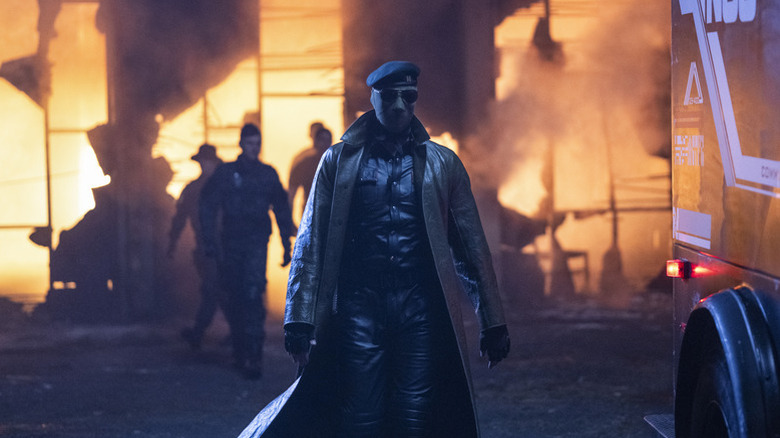
In the film, McCone is not only a sadistic and ruthless killer, but an entertainer who loves putting on a show. Played by Pace, he’s practically a “Metal Gear Solid” villain — not just because of his mask and outfit, but because he literally names his weapons. The guy even has a catchphrase.
Towards the end of the film, Ben is led to believe that the hunters broke the rules of the game and killed his family. Blinded by grief and rage, Ben goes on a killing spree and eliminates the Hunters, but when he confronts McCone, the Hunter reveals that he was actually once a contestant on “The Running Man” – and not just any contestant, but the longest-surviving one from the show’s first season. Like Ben, he was offered the choice of taking a contract to work for the network, becoming a hunter with his own crew, and living a comfortable life.
This revelation is a cruel twist of fate, building on the central idea that no one can ever win “The Running Man” because it would give too much hope to those disillusioned with the network. Candidates may survive for a long time and even become temporary celebrities, but the authoritarian regime cannot let a symbol of hope live long enough to light the fire of rebellion. Additionally, as McCone reveals, even as a “free” man, his family remains distant from him, essentially hostages to the network so that he never forgets who he works for.
Surprisingly, this wasn’t in the novel “The Running Man,” so for all the talk about how the movie changes things, the best idea in Edgar Wright’s adaptation is entirely original, but still seems perfectly suited to this story.


