
Explore
IIt looks like the orcas are ready for their close-ups. This week, the charismatic marine mammals made headlines for two very different activities, both captured in unprecedented detail.
On Sunday, a group of Norwegian scientists witnessed and recorded in real time the birth of an orca. This may be the first time such an event has been photographed in nature. Writing on its Facebook page, Orca Channel reported on the cetacean delivery, which took place off the coast of Skjervøy, in the Arctic Circle. “We were floating calmly and watching the feeding, when suddenly, near the boat, blood was flowing and splashing everywhere…” wrote Krisztina Balotay, a photographer and videographer at Orca Channel, a wildlife documentary and tours site. “At first, I had no idea what was happening. A moment later, I saw a little head sticking out of the water…”
Read more: »The story of a lonely orca»
Whale watchers aboard the Orca Channel boat and another group, from the Norwegian Orca Survey, waited nervously for about 15 minutes as the newborn orca struggled to breathe and swim on its own. But with the help of group members, who formed a perimeter around the vulnerable calf and supported it on its back above the water until it was able to swim on its own.
ADVERTISEMENT
Nautilus members enjoy an ad-free experience. Log in or register now.
“This event represents a historic first: the first ever documentation of the birth of a killer whale and the newborn’s first hour of life in the wild,” wrote the Norwegian Orca Survey, a conservation group, on its Facebook page. “Our observations will allow us to identify the individuals involved and understand their role in supporting the calf during its first moments. We are currently working to gather all available data and plan to publish the full documentation as a scientific article in the near future.”
On the other end of the life spectrum, orcas have been documented employing a deadly strategy to prey on one of the ocean’s deadliest predators: the great white shark.
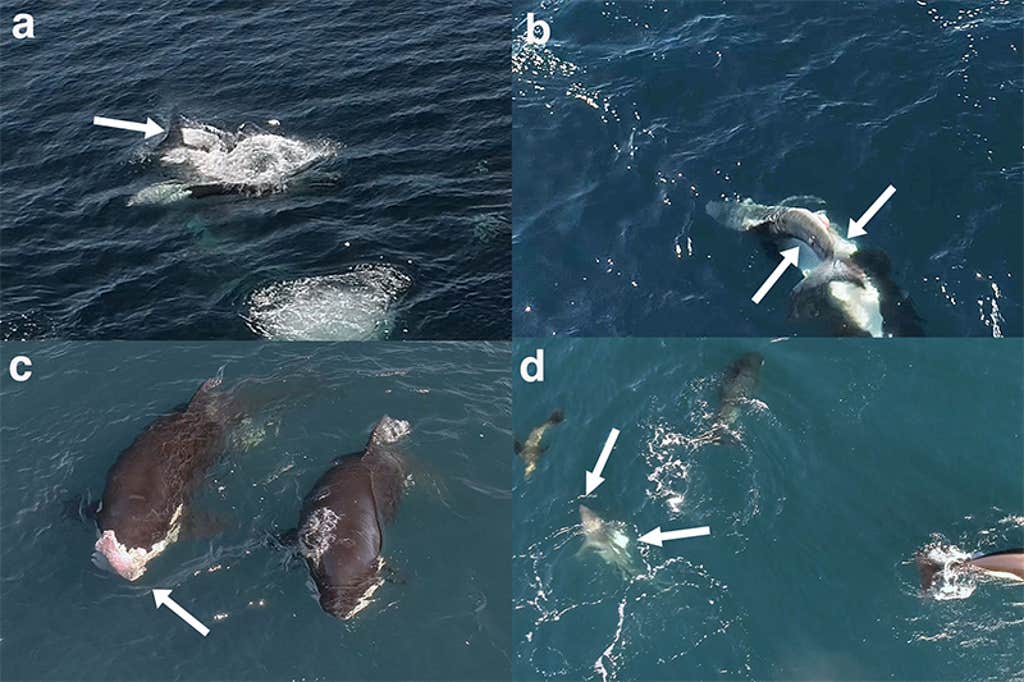
The researchers published a report this week in Frontiers of marine science detailing the shark-hunting strategy of a pod of orcas in the Gulf of California, off the coast of Mexico. In two separate incidents, both filmed using aerial drones, orcas surrounded juvenile great white sharks, flipping them onto their backs (which immobilizes the sharks) and ripping out their livers, sharing the spoils of the hunt. Hey, there’s a reason they deserve the nickname “killer whales.”
ADVERTISEMENT
Nautilus members enjoy an ad-free experience. Log in or register now.
Orcas are always fascinating sea creatures. Scientists continue to learn new things about the species as they observe its behavior. From standing guard around a struggling newborn to inventive hunting tactics to take down an ocean assassin, orcas likely have more secrets to share. And humans, now equipped with ever more advanced tools to record new behaviors, seem up to the challenge.
Enjoy Nautilus? Subscribe to our free newsletter.
Main image: MuhammadIshfaq1 / Shutterstock


