
Using the[{” attribute=”” tabindex=”0″ role=”link”>James Webb Space Telescope, scientists uncovered bizarre atmospheric structures on Saturn, including drifting “dark beads” in the ionosphere and an asymmetric star pattern in the stratosphere.
Both may connect to Saturn’s iconic hexagonal storm, but their true nature remains a mystery.
Webb Telescope Unveils Saturn’s Atmospheric Mysteries
A new investigation of Saturn’s upper atmosphere, carried out with the James Webb Space Telescope (JWST), has uncovered strikingly unusual features never before observed on any planet in the Solar System. The findings were unveiled last week by Professor Tom Stallard of Northumbria University during the EPSC-DPS2025 Joint Meeting in Helsinki.
“This opportunity to use JWST was the first time we have ever been able to make such detailed near-infrared observations of Saturn’s aurora and upper atmosphere. The results came as a complete surprise,” said Professor Stallard.
https://www.youtube.com/watch?v=otkuqxvjcny
This video shows how the structures observed in the ionosphere and the Seturne stratosphere relate to each other. Starting with the Aurora at 1100 km, the brightness is increased to reveal the characteristics of dark pearls. The video then fades in stars in the 600 km underlying layer. The darkest pearls of the ionosphere seem to line up with the strongest arm below, but it is not clear if this is fortuitous, or if it suggests a coupling between the lowest and highest layers of Saturn of the atmosphere. Credit:[{” attribute=”” tabindex=”0″ role=”link”>NASA/ESA/CSA/Stallard et al 2025.
Beads, Stars, and the Unexpected Patterns
“We anticipated seeing emissions in broad bands at the various levels. Instead, we’ve seen fine-scaled patterns of beads and stars that, despite being separated by huge distances in altitude, may somehow be interconnected – and may also be linked to the famous hexagon deeper in Saturn’s clouds. These features were completely unexpected and, at present, are completely unexplained.”
The discovery was made by an international collaboration of 23 researchers from the UK, US, and France, who observed Saturn for a continuous 10-hour stretch on November 29, 2024, while the planet rotated under JWST’s gaze.
Hydrogen Ions and Methane Molecules Under the Lens
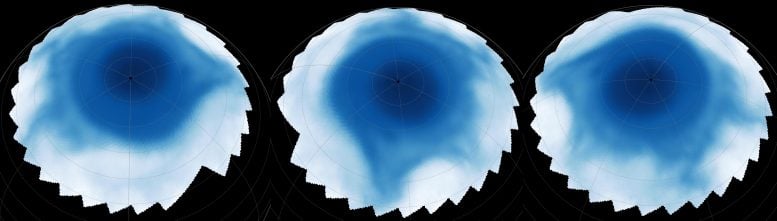
The team focused on detecting infrared emissions by a positively charged molecular form of hydrogen, H3+, which plays a key role in reactions in Saturn’s atmosphere and so can provide valuable insights into the chemical and physical processes at work. JWST’s Near Infrared Spectrograph allowed the team to simultaneously observe H₃⁺ ions from the ionosphere, 1,100 kilometers above Saturn’s nominal surface, and methane molecules in the underlying stratosphere, at an altitude of 600 kilometers.
In the electrically charged plasma of the ionosphere, the team observed a series of dark, bead-like features embedded in bright auroral halos. These structures remained stable over hours but appeared to drift slowly over longer periods.
https://www.youtube.com/watch?v=6yurglt-ma0
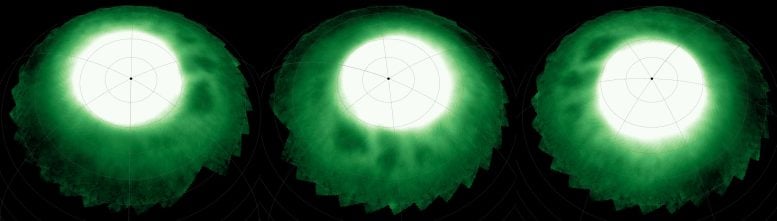
This video of the Saturn stratosphere shows a complex and very surprising structure in the shape of a star, revealed for the first time by an unprecedented sensitivity of JWST. Four dark bands extend from the polar region, seeming to constitute four arms out of six which line up with the famous hexagon of Saturn in the lower atmosphere. At this stage, we do not know why the dark arms flow towards the equator, or why two of the arms are missing, but the causes can be associated with the structures of complex balls observed several hundred kilometers above the ionosphere. Credit: NASA / ESA / CSA / Stallard et al 2025.
Unbalanced star on the northern pole of Saturn
About 500 kilometers below, in the Seturne stratosphere, the team discovered an asymmetrical characteristic in the shape of a star. This unusual structure has extended from the North Pole of Saturn to the Ecuador. Only four of the six star of the star were visible, with two mysteriously missing, creating an unbalanced pattern.
“Saturn’s upper atmosphere has proven incredibly difficult to study with telescope missions and installations to date due to extremely weak emissions from this region,” said Professor Stallard. “The incredible sensitivity of JWST has revolutionized our ability to observe these atmospheric layers, revealing structures that are completely different from everything we have seen on any planet.”
Connection to the hexagon storm of Saturn
The team has mapped the exact locations of the characteristics and found that they superimposed the same region of Saturn at different levels, the arms of the star seeming to emanate from positions directly above the points of France at the level of the N-storm. This suggests that the processes that drive models can influence a column extending through the atmosphere of Saturn.
“We believe that dark pearls can result from complex interactions between the magnetosphere of Saturn and its rotary atmosphere, potentially offering new information on the exchange of energy which leads to an dawn of Saturn.
https://www.youtube.com/watch?v=nqnvv_k5dfq
This video of the ionosphere of Saturn highlights the contrast of brightness between the infrared observations of JWST on the Aurora and the characteristics of dark balls. The Aurora itself is relatively low, almost impossible to image from the earth, requiring hours of integration time to observe the use of data on the ground. However, the auroral characteristics are at least four times brighter than the brightest parts of the characteristics of the dark pearls, therefore to correctly show the hidden characteristics, the Aurora is completely saturated. Credit: NASA / ESA / CSA / Stallard et al 2025.
Coincidence or cosmic link?
“Sizant, the darkest pearls of the ionosphere seem to line up with the strongest star arm in the stratosphere, but it is not clear at this stage if they are really linked or if it is simply a coincidence.”
Although the two features can have important implications for understanding atmospheric dynamics on giant gas planets, more work is necessary to provide explanations for underlying causes.
Seasonal changes and emergency for follow -up
The team hopes that additional time could be granted in the future to make Saturn follow -up observations with JWST to further explore functionality. With the planet at its equinox, which occurs about every 15 years of earth, the structures can change considerably while the orientation of Saturn towards the Sun moves and the northern hemisphere moves in autumn.
“Since no atmospheric layer can be observed using the ground telescopes, the need for JWST monitoring observations during this key period of seasonal change on Saturn is pressed,” added Stallard.
References:
“The transformational observations of JWST on the ionospheres of Géante Géante” by Tom Stallard, Henrik Melin, Luke Moore, Emma Thomas, Katie Knowles, Paola Tiranti and James O’Donoghue, July 8, 2025, EPSC summary.
DOI: 10.5194 / EPSC-DPS2025-817
“JWST / NIRSPEC detection of complex structures in the ionosphere and the under-ARORAL STRATOSPHE of Saturn” by Tom S. Stallard, Luke Moore, Henrik Melin, Omakshi Agiwal, Mr. Nahid Chowdhury Ingo Mueller-Wodarg, Leight Fletcher, Imke de Pater, Thierry Fouchet and Sarah V. Badman, August 28, 2025, Geophysical research letters.
DOI: 10.1029 / 2025GL116491
Saturn research has been supported by subsidies from science and technology facilities Council (STFC), the NASA solar system work and the European Research Council. The study represents a part of the revolutionary observations during JWST of the planets of our solar system.
Never miss a breakthrough: join the Scitechdaily newsletter.


:max_bytes(150000):strip_icc()/VWH-GettyImages-1487410688-50ae07eb150141f2a23a1392d63d4b30.jpg?w=390&resize=390,220&ssl=1 "The best time to take melatonin for better sleep, according to science")


