
Scientists found Amore6, a galaxy almost without heavy elements. Its existence strongly supports the key forecasts of the[{” attribute=”” tabindex=”0″ role=”link”>Big Bang model.
Our knowledge of the Universe begins with the Big Bang, the moment when cosmic expansion first began. During this event, a process called Big Bang nucleosynthesis produced only the lightest elements: hydrogen, helium, and trace amounts of lithium. Heavier elements, which astrophysicists refer to as metals, were created later in the hearts of stars that lived and died after this first epoch.
The earliest generation of stars, known as Population III stars, were the first to forge these heavier elements through stellar nucleosynthesis. These stars themselves contained no metals, or at most extremely small amounts, and their life cycles enriched the Universe with its first metals. Because stars are born in galaxies rather than in isolation, there must also have been Population III galaxies whose stellar populations contained no metals at all.
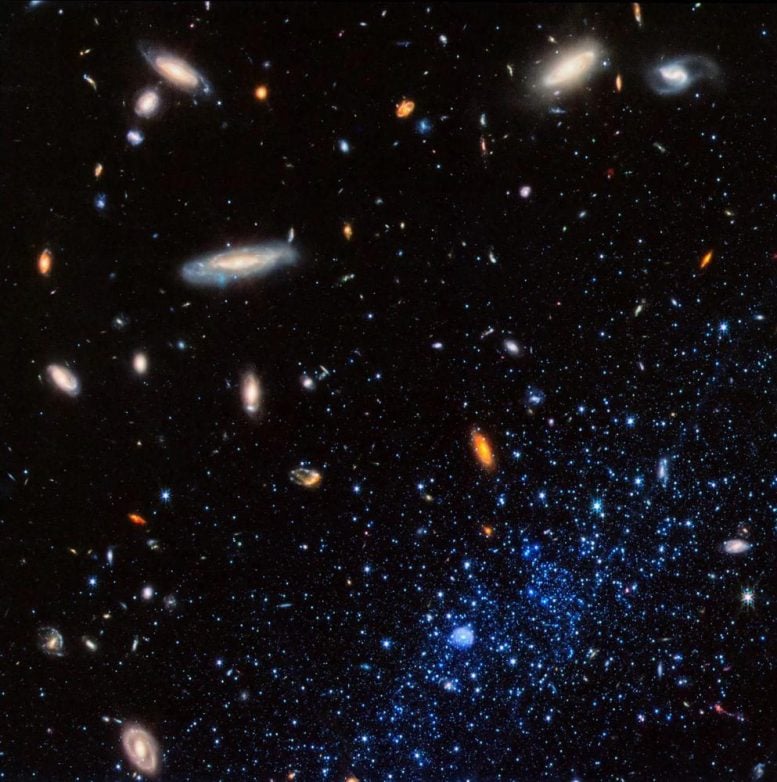
Despite progress in understanding cosmic history, significant gaps remain. One of the most important missing pieces is evidence for these Population III galaxies. Theory predicts that some early galaxies, observed at high redshifts, should display zero metallicity. Confirming their existence would provide crucial support for our current cosmological framework.
Surprising results from JWST
The James Webb Space Telescope (JWST) has already reshaped expectations by revealing massive, well-developed galaxies far earlier in cosmic history than models had predicted. According to previous understanding, galaxies of that size and maturity should not have appeared so soon after the Big Bang. These discoveries have forced astronomers to reconsider how quickly galaxies formed and evolved.
Yet, even with its remarkable capabilities, JWST has not definitively identified a zero-metallicity galaxy. While it has observed galaxies that emerged only a few hundred million years after the Big Bang, none of them have yet shown the complete absence of metals predicted for true Population III systems.
The role of OIII emissions
Oxygen plays an essential role in this search. According to cosmological models, the earliest galaxies should contain only hydrogen and helium, with no oxygen or other heavier elements. Astronomers use the OIII emission line in spectroscopy to study galaxies: it reveals ongoing star formation and is especially effective at probing very distant, high-redshift systems. JWST, with its sensitivity, has made these measurements even more powerful.
In primitive galaxies, strong OIII emissions can indicate very low metallicity. Conversely, weak OIII signals suggest galaxies formed under conditions unlike those seen today. Until recently, no convincing example had been found.
That may now be changing. New research submitted to Nature reports the possible discovery of a galaxy that fits the criteria for being pristine. The study is led by Takahiro Morishita, a staff scientist at the Infrared Processing and Analysis Center (IPAC) at the California Institute of Technology.
“The existence of galaxies with no elements such as Oxygen – formed by stars after Big Bang nucleosynthesis – is a key prediction of the cosmological model,” the researchers write. “However, no pristine “zero-metallicity” Population III galaxies have been identified so far.”
Confirming the Big Bang model
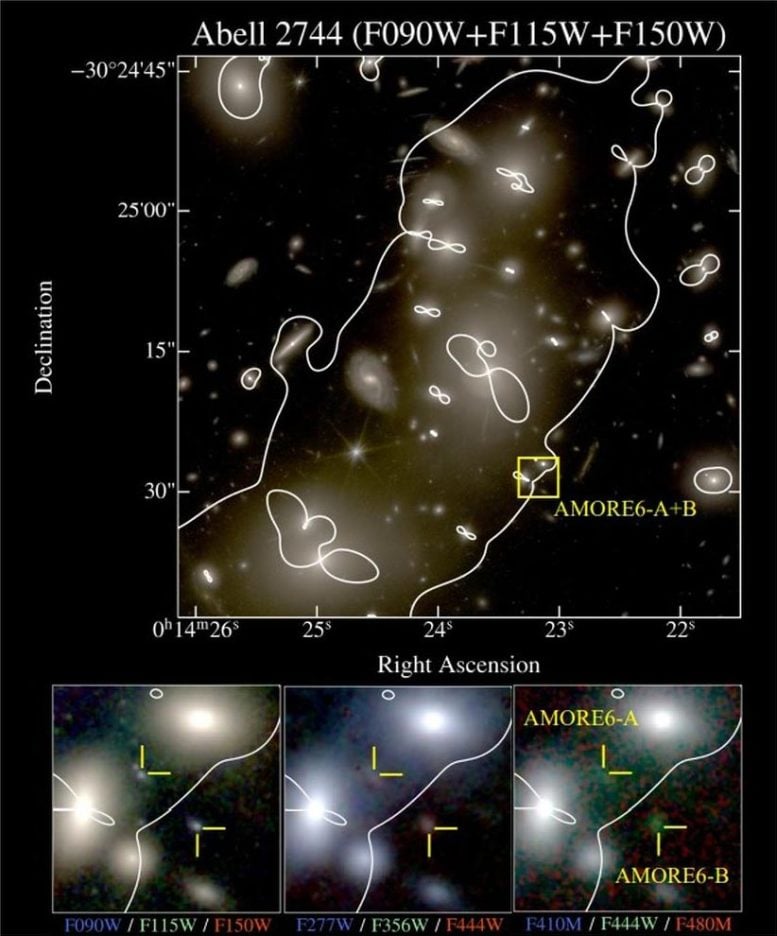
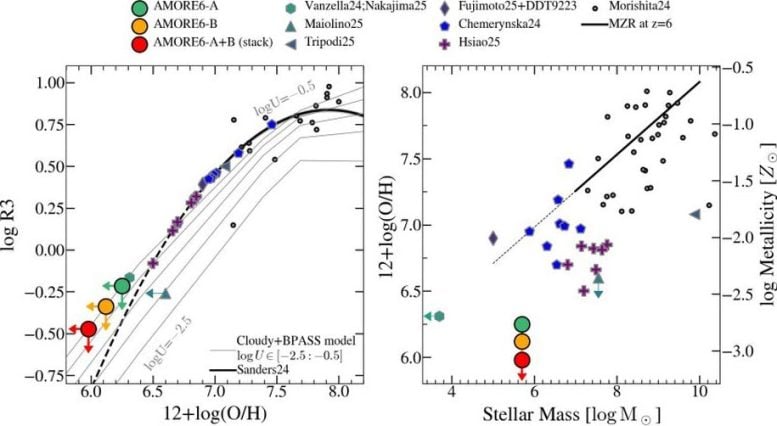
Until now. Morishita and his co-authors have found a galaxy that fits the description. They detected it at redshift z = 5.725, meaning its light was emitted when the Universe was only about 900 million to 1 billion years old. It’s named AMORE6 and was detected through gravitational lensing. This magnified and duplicated the images of the galaxy, making it easier to observe. The JWST found Hβ emissions, an important line in astronomy used to measure galaxies in different ways, but it didn’t detect any oxygen. That means its metallicity is very low. “The absence of [O iii] Immediately indicates that Demore is home to a very low, almost virgin interstellar environment, ”explains the authors.
The galaxy also shows a low stellar mass and an extremely compact morphology. “These properties are consistent with a massive training of stars in a virgin or quasi-accidental environment,” write the authors. The fact is that this galaxy is not as old as certain previously formed galaxies that the JWST has found. It is somewhat confusing that this strong example of a virgin and low metalicity star formation environment found itself almost a billion years after the Big Bang.
More studies will be necessary to confirm these results and understand them in more detail. But detection suggests that we are on the right track to understand nature.
“The conclusion of such an example in a relatively late period of cosmic history is surprising,” write the researchers. “However, whatever the cosmic era, the identification of a potentially virgin object is a key validation of the Big Bang model.”
Reference: “Massive stars formation virgin captured at the break of the cosmic dawn” by Takahiro Morishita, Zhaoran Liu, Massimo Stiavelli, Tommaso Treu, Pietro Bergamini and Yechi Zhang, July 31, 2025, Arxiv.
DOI: 10.48550 / Arxiv.2507.10521
Adapted from an article originally published on Universe today.
Never miss a breakthrough: join the Scitechdaily newsletter.


:max_bytes(150000):strip_icc()/GettyImages-503539812-085f1ea7a9a74502966d04cdf10a011a.jpg?w=390&resize=390,220&ssl=1 "12 Foods That Can Help Strengthen Your Immune System Naturally")

:max_bytes(150000):strip_icc()/VWH-GettyImages-2222683831-22b0103113cc40a69871419f87f1a0ba.jpg?w=390&resize=390,220&ssl=1 "Best Time to Take Echinacea for the Greatest Immune Boost")
