
Egon CossouEconomic journalist
 Trinity Metals
You probably don’t give much thought to the device you’re reading this on, as long as it looks good and continues to work.
But the elements that rule and direct it are the subject of a growing struggle between the world’s two largest economies – the United States and China – with African countries in the eye of the storm.
The African continent is rich in essential minerals and metals – such as lithium, rare earths, cobalt and tungsten – which are essential to the manufacture and operation of our personal technology. These materials are also essential for everything from electric vehicles to AI data centers and weapons systems.
China has long been the largest player in the global market for critical minerals and metals. It has significant domestic reserves and access to foreign supplies through significant investment in foreign mining operations, particularly in Africa.
Beijing has also built a dominant position in handling global supplies, and rattled the United States by threatening to curb its exports. This lends added urgency to moves by the United States to increase its access to essential minerals and metals, with African reserves seen as key to this mission.
This is so true that the United States has quietly overtaken China as the largest foreign direct investor in Africa, according to the latest annual figures. The US has invested $7.8bn (£6bn) across Africa in 2023, compared to China’s $4bn, according to the China Africa Research Initiative at Johns Hopkins University, which accessed official data.
This is the first time since 2012 that the United States has regained the lead.
This American investment is led by a government agency called the US International Development Finance Corporation (DFC). Created in 2019, during President Trump’s first term, it does not hesitate to affirm that its mission is to attack Beijing. The DFC says on its website that it was created to “counter China’s presence in strategic regions.”
What does this investment mean for African companies and the countries that benefit from it?
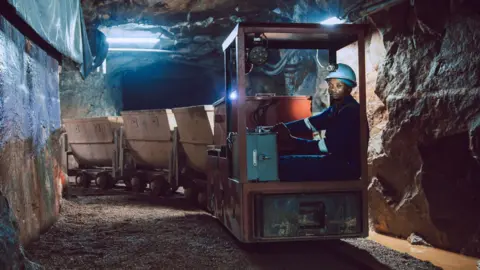
Last year, Rwandan mining company Trinity Metals secured a $3.9 million grant from the DFC to help it develop the three mines it owns in the country, producing tin, tantalum and tungsten.
“The U.S. government has been very supportive of our efforts to bring this supply chain directly to the United States,” said company President Shawn McCormick.
Trinity now ships tungsten from Rwanda to a processing plant in Pennsylvania. He also struck a deal to send Rwandan tin to a smelter in Pennsylvania.
Mr. McCormick denies that funding from Washington influenced the company’s decision to send supplies to the United States.
“It wasn’t the U.S. government that said to the CEO and me, ‘could you please bring this tungsten to America?’ This is our decision as commercial market participants.
Trinity is 5% owned by the Rwandan government, and Irish critical minerals investment company TechMet is also a shareholder.
Mr McCormick adds that although some mining operations in Africa may use untrained workers working in unsafe conditions, Trinity adheres to the highest standards.
“We have shown that there is a way to produce these materials without conflict or child labor, in a professionalized way, paying taxes and respecting the community and the environment, creating jobs and opportunities.”

 AFP via Getty Images
Sepo Haihambo is an economist and former executive of the FNB Namibia banking group. She says African nations must be firm in defending their national interests when negotiating with US entities, and should not expect favors.
“Expect [the Americans] to come forward, negotiate and propose clauses that are in the best interest of Africa, on behalf of Africa, would be unrealistic,” she says. “Africa must therefore really prepare for these commitments and be very clear on what [outcomes] it wants.”
Haihambo adds that African governments should move away from simple cash-for-mineral transactions. “Rather, there is an opportunity to look at different frameworks,” she says.
“You could look at production sharing agreements, joint venture models, local equity participations. Ultimately, that then creates an opportunity for African countries to create, perhaps, sovereign wealth funds that can then invest in areas of development like education, health, etc.”
She also wants to see more processing of minerals and metals in Africa, rather than just exporting the minerals abroad, as this would be more financially lucrative.
 Sepo Haihambo
An American company building a minerals and metals refinery in Africa is ReElement Africa, a subsidiary of the American group American Resources. ReElement Africa is building the refinery in the South African province of Gauteng.
“It was extremely rewarding to realize that we could partner with countries in Africa to install refining facilities alongside the resources in mining projects, so that we could actually capture more value, upskill the workforce, build an economy around that area and lay the foundation for further industrial development,” said Ben Kincaid, CEO of ReElement Africa.
However, Professor Lee Branstetter, an international economist at Carnegie Mellon University in Pittsburgh, says the United States has missed a trick.
He says Trump’s tariffs on African countries have reduced enthusiasm for the United States across the continent, at a time when some sub-Saharan African countries complain that Chinese investments do not sufficiently benefit local populations.
“If the current administration had not imposed indiscriminate tariffs on a large number of African countries, for no apparent reason, the United States would likely have been in a better position to benefit from African disaffection with Chinese projects,” says Professor Branstetter.
In the future, the United States and China may also face increased competition from other countries in Africa, Ms. Haihambo adds. She highlights growing interest in the continent from countries like Brazil, India and Japan.


