
Cutting-edge methodologies
Painting of Napoleon’s army.
Credit: Barbieri et al., Current Biology/CC BY-SA
Rascovan and his co-authors note in their paper that the 2006 study relied on outdated PCR-based technologies for its DNA analysis. As for the family of viruses detected in Kalingrad dental pulp, they say these viruses are both ubiquitous and generally asymptomatic in humans – and therefore unlikely to be the main culprits of the diseases that wiped out the French army. So Rascovan’s team decided to use today’s cutting-edge DNA methodologies to reanalyze a different set of remains of Napoleonic soldiers who died in Vilnius.
“In most ancient human remains, pathogen DNA is extremely fragmented and present only in very small amounts, making it very difficult to obtain entire genomes,” Rascovan said. “We therefore need methods that can unambiguously identify infectious agents from these weak signals, and sometimes even identify lineages, to explore the pathogenic diversity of the past. »
An 1812 report by one of Napoleon’s doctors, JRL de Kirckhoff, specifically noted typhus, dysentery, and diarrhea after the soldiers’ arrival in Vilnius, which he attributed to the large barrels of salted beets consumed by the starving troops, “greatly upsetting us and strongly irritating the intestinal tract.” Rascovan et al. note that such symptoms could accompany a number of conditions or illnesses common to 19th-century Europe. “Even today, two centuries later, it would still be impossible to make a differential diagnosis between typhus, typhoid or paratyphoid fever based solely on the symptoms or testimonies of survivors,” the authors write.
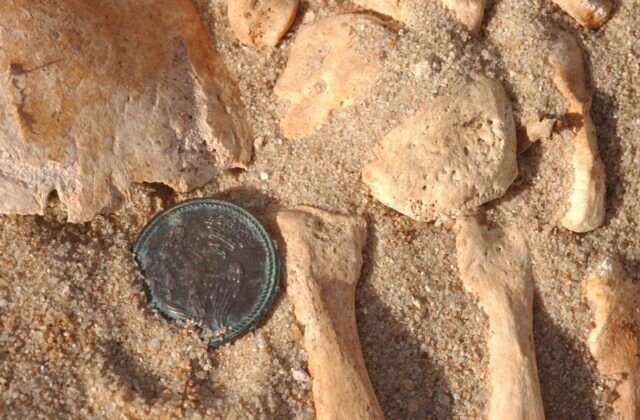
Imperial Guard button discovered during excavations.
Credit: UMR 6578 Aix-Marseille University, CNRS, EFS
More than 3,200 individual remains, almost all of men aged between 20 and 50, were exhumed from the Vilnius mass grave. Rascovan et al. focused on 13 teeth from 13 different individuals. To compensate for the degraded nature of the 200-year-old genome fragments, co-authors from the University of Tartu in Estonia helped develop a multi-step authentication method to more accurately identify pathogens in the samples. In some cases, they were even able to identify a specific lineage.


