

Pallab GhoshScientific correspondent

 David Brown
The very first humans, millions of years ago, could have been inventors, according to a discovery made in northwestern Kenya.
Researchers found that primitive humans who lived 2.75 million years ago at an archaeological site called Namorotukunan used stone tools continuously for 300,000 years.
Evidence previously suggested that early human tools were sporadic: developed haphazardly and quickly forgotten.
Namorotukunan’s discovery is the first to show that technology has been passed down through thousands of generations.
According to Professor David Braun, of George Washington University, Washington DC, who led the research, the discovery, published in the journal Nature Communications, provides incredibly strong evidence of a radical shift in our understanding of human evolution.
“We thought tool use could have been a flash in the pan and then disappeared. When we see 300,000 years of the same thing, it’s just not possible,” he said.
“It’s a long continuum of behavior. The use of this tool in (humans and their ancestors) is probably much earlier and continuing than we thought.”
 David Brown
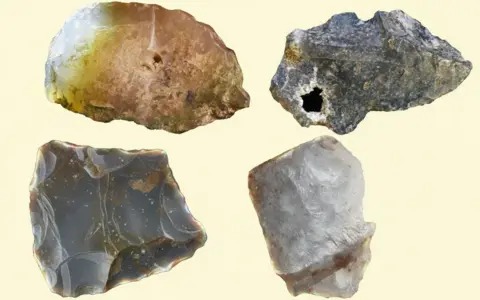
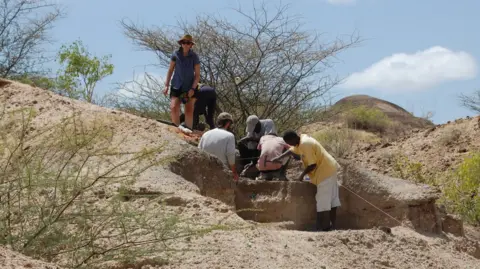
Archaeologists spent ten years at Namorotukunan discovering 1,300 sharp flakes, hammerstones and stone cores, each made by carefully striking rocks collected from riverbeds. These are made using a technology known as Oldowan and is the first widely used method of making stone tools.
The same types of tools appear in three distinct layers. The deeper the layer, the further back in time the snapshot is. Many of the stones were specifically chosen for their quality, suggesting that the creators were skilled and knew exactly what they were looking for, according to the research team’s lead geoscientist, Dr. Dan Palcu Rolier of the University of São Paulo in Brazil.
“What we see here at the site is an incredible level of sophistication,” he told BBC News.
“These guys were extremely astute geologists. They knew how to find the best raw materials and these stone tools are exceptional. You could basically cut your fingers on some of them.”
Geological evidence suggests that tool use likely helped these people survive dramatic climate changes.
The landscape changed from lush wetlands to dry, fire-swept grasslands and semi-deserts,” said Rahab N. Kinyanjui, senior scientist at the National Museums of Kenya.

These abrupt environmental changes would normally force animal populations to adapt over the course of evolution or move away. But the region’s toolmakers have managed to thrive by using technology rather than biological adaptation, according to Dr. Palcu Rolier.
“Technology allowed these early inhabitants of East Turkana to survive in a rapidly changing landscape – not by adapting, but by adapting their ways of finding food.”
Stone tool traces at different layers show that over a long and continuous period, these primitive people dealt with biological evolution, finding a way to control the world around them, rather than letting the world control them.
And this happened at the very beginning of the emergence of humanity, according to Dr. Palcu Rolier.
“The use of tools meant that they did not need to evolve by modifying their bodies to adapt to these changes. Instead, they developed the technology they needed to access food: tools to open animal carcasses and dig up plants.”
 David Brown
There is evidence of this at the site: broken animal bones, cut with these stone tools, meaning that through these changes they were still able to use meat as a means of subsistence.
“Technology gives these first inhabitants an advantage,” explains Dr. Palcu Rolier.
“They can access different types of foods as environments change, their source of sustenance changes, but with this technology they can bypass those challenges and access new foods.”
 David Brown
About 2.75 million years ago, the region was populated by some of the earliest humans, with relatively small brains. These early humans are thought to have lived alongside their evolutionary ancestors: a prehuman group, called australopithecines, who had larger teeth and a mix of chimpanzee and human traits.
The users of the tool in Namorotukunan most likely belonged to one or both of these groups.
And the discovery challenges the idea held by many human evolution experts that continued tool use emerged much later, between 2.4 and 2.2 million years ago, when humans had evolved relatively larger brains, according to Professor Braun.
“The argument is that we’re seeing a pretty substantial increase in brain size. And so it’s often been argued that using tools allows them to feed that big brain.
“But what we see in Namorotukunan is that these very early tools are used before brain size increases.”
“We probably greatly underestimated these early humans and human ancestors. We can actually trace the roots of our ability to adapt to change using technology much earlier than we thought, to 2.75 million years ago, and probably much earlier.”


