Conservationists connect with chimpanzees in a Ugandan rainforest as they seek a sense of communion

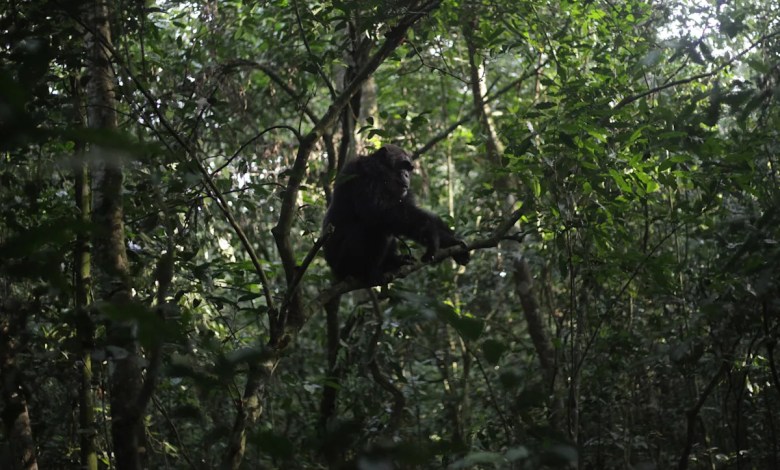
KIBALE NATIONAL PARK, Uganda (AP) — The man who tracks the movements of chimpanzees in a rainforest must follow the primates everywhere they go except into the trees.
Onesmas Ainebyona tracks chimpanzees with such spiritual determination that he managed to gain the trust of a chimpanzee leader named Jean, who came down from a tree one recent morning while Ainebyona lingered nearby.
It took Ainebyona four years to establish a relationship with Jean, an alpha male so accustomed to people that he pretends to sleep while tourists make a racket that forces the other chimpanzees to leave.
Wildlife authorities describe the process of allowing chimpanzees to appear comfortable around humans as “habituation,” a term that fails to capture the struggle between man and beast as they try to understand — and tolerate — each other.
Ainebyona and others involved in chimpanzee conservation in this remote Ugandan rainforest say they are aiming for the kind of communion that initially irritates the chimpanzees. It can take several years for chimpanzees to habituate. Conservation efforts that employ men like Ainebyona not only trace the monkeys’ movements, but also help ensure that chimpanzees like Jean don’t die young.
“The work requires patience,” Ainebyona said. “Passion too. You have to worry about it.”
Ainebyona doesn’t leave the forest even when it rains. “You accept,” he said. “The rain must beat you, but you can’t abandon the chimpanzee.”
Primate capital
The rainforest of western Uganda is part of Kibale National Park, a protected area described by some as the primate capital of the world. Species range from colobus monkeys to chimpanzees, a major tourist attraction.
But tourists cannot be lured into tracking down wild chimpanzees, which flee deeper into dense areas of mountain forest and are known to be violent in clashes over territory. Instead, rangers lead tourists to one of three groups of habituated chimpanzees, which range in number from dozens to more than 100 in a group. Kibale’s chimpanzees now number at least 1,000, many of them wild.
Even habituated chimpanzees remain relatively wary of people, and only a few – like Jean of the Kisongi group, which includes around 80 monkeys – appear to have completely overcome any discomfort in the presence of people.
“Jean is my friend,” Ainebyona said one recent morning as tourists gathered nearby. The strong and flamboyant chimpanzee in his twenties lay on his back and raised his feet.
The connection between Ainebyona and Jean was sealed in July when the chimpanzee showed up one day with a wire trap clutching her hand, an injury that threatened to cut off her finger. Ainebyona was among those who removed the thread that Jean had picked up as he wandered away from the forest to steal sugar cane.
Ainebyona is one of four men working in shifts as chimpanzee regulars in Jean’s group. When the chimpanzees rest, the humans squat in the mud nearby. When primates go hiking, they walk alongside them, sometimes even grunting like them.
Ainebyona wears binoculars and takes note of what he sees. The aim is to increase chimpanzee numbers and generate more tourism revenue. In Kibale, a permit to track chimpanzees costs a foreign visitor $250.
Transforming wild chimpanzees
Tour guide Alex Turyatunga told The Associated Press that the habituation process is enlightening. He and his colleagues have been trying to fully acclimate to the Kisongi group for more than a decade, he said.
“We’re trying to learn more about these chimpanzees, but they’re also trying to learn more about us,” Turyatunga said.
To be successful, regulars can focus on alphas like Jean, targeting them repeatedly until other group members notice their comfort around people. One person can help others “get involved,” Turyatunga said.
The common chimpanzee is one of the two primate species with the closest evolutionary ties to humans. Scientists cite nearly 99% DNA similarity between humans and chimpanzees – similar for bonobos.
Regulars like Ainebyona must show a willingness to interact closely with the chimpanzees, said Kibale tourism manager Ankunda Viola Ariho.
“We look at attitude. It’s very important,” she said of the regulars. “You’re not going to work doing this job if you don’t love what you do.”
The work of Jane Goodall
Jane Goodall, the world-renowned primatologist who died in October, formed strong bonds with the chimpanzees she studied in Tanzania’s Gombe National Park. His work helped shape a sympathetic view of the chimpanzee as an emotionally complex creature. The species is listed by the International Union for Conservation of Nature as endangered, facing threats including poaching and habitat loss.
Kibale National Park was given enhanced protection status in 1993 after the forest was encroached upon by hundreds of people who built houses there and felled trees for firewood. The park is now thriving, in part due to habituation efforts that allow tourists to directly contribute to chimpanzee conservation.
Accustoming chimpanzees can open up research opportunities that would not otherwise be possible, and Kibale is home to one of the oldest field stations in the tropics, said David Morgan, who co-leads the Goualougo Triangle Ape project in the Republic of Congo.
“If chimpanzees don’t want to be seen, they’re incredibly good at disappearing,” said Morgan, who is also a chimpanzee and gorilla expert at Chicago’s Lincoln Park Zoo.
Chimpanzee habituation and associated tourism can improve the way the public interacts with the monkeys, he said.
“Communities that are habituated serve as sort of an emblem of the importance of what we can learn from them and what we stand to gain by protecting them and what we stand to lose by not protecting them,” Morgan said.
Turyatunga uses a walkie-talkie when he ventures into the forest, occasionally asking regulars if they have a close, clear view of the chimpanzees. Indeed, chimpanzees, even habituated ones, are more likely to be seen in trees.
“You listen for the calls early in the morning when they come out of the nests. Then introduce yourself to the chimpanzees: they see you’re there, that’s all,” he said. “Stay with them. If they move, follow them.”
___
Holly Meyer contributed to this report from Nashville, Tennessee.
___
Associated Press religion coverage receives support through the AP’s collaboration with The Conversation US, with funding from Lilly Endowment Inc. The AP is solely responsible for this content.


:max_bytes(150000):strip_icc()/kale-plant-1150150196-4103527c07a8465fb4b4793f76835cb7.jpg?w=390&resize=390,220&ssl=1 "Embred the gardening in a closed loop, never go back")
