
Verified satellite images and videos paint a harrowing picture of door-to-door massacres in war-torn Sudan’s Darfur region as paramilitary Rapid Support Forces (RSF) rebels seized a key town in the region.
The Humanitarian Research Laboratory (HRL) at the Yale School of Public Health says it observed numerous clumps with discoloration around them, consistent with the appearance of human bodies across the city as RSF moved forward.
The apparent masses were seen at a hospital, in all residential areas, on the outskirts of the city and near military bases of the opposing Sudan Armed Forces (SAF).
The alleged killings took place “less than 72 hours after RSF took control of the city,” Nathaniel Raymond, a U.S. human rights and war crimes investigator at HRL, who documented the massacres in Sudan with satellite images, told ABC News.
With his research lab team, Raymond said he observed “an explosion of objects measuring between 1.3 and 2 meters proliferating all over the ground,” which HRL Yale concluded were human bodies based on the length, shape and videos of the ground showing alleged systematic killings of civilians.
The Humanitarian Research Laboratory (HRL) at the Yale School of Public Health observed numerous clumps with discoloration around them, consistent with the appearance of human bodies in the Darfur region of Sudan.
Humanitarian Research Laboratory at the Yale School of Public Health
“In Daraja Oula – a neighborhood where civilians are hiding – we are seeing a tactical posture on vehicles that is entirely consistent with house-to-house massacres,” Raymond told ABC News. “This also matches the video and the testimonies of those who arrived in Tawila. Particularly the women, who said the men were separated by RSF and then heard gunshots.”
The research lab also observed discoloration around these objects, which they concluded was blood, which was also confirmed by the presence of Rapid Support Forces (RSF) military vehicles, always spotted nearby, Raymond said. An update to the report shows the piles have grown and none of the original objects have moved, Raymond told ABC News.
The researchers said they also corroborated reports of alleged executions at the Saudi hospital, where at least four groups of bodies appeared. “We see a line of people standing on the first day in an RSF detention center that was once a children’s hospital. On the second day, we now see a pile in the corner that matches the color and length of the individuals who were in line the day before,” Raymond said.

The Humanitarian Research Laboratory (HRL) at the Yale School of Public Health observed numerous clumps with discoloration around them, consistent with the appearance of human bodies in the Darfur region of Sudan.
Humanitarian Research Laboratory at the Yale School of Public Health
In the suburb of El Fasher, HRL Yale also said it observed multiple outbreaks between October 26 and 27, consistent with reports of civilians being killed while trying to flee. To the west of the city, along the surrounding sea wall, at least six piles of bodies were observed along with adjacent technical vehicles, which were not visible in the images from October 28, suggesting that RSF had moved, leaving the large piles of bodies behind, according to the research laboratory.
RSF also took control of opposing Sudanese Armed Forces (SAF) military bases in the city, HRL analysis appears to show.
Satellite images from October 26 show at least 15 new munitions scars and thermal burns on the ground of the headquarters of the 6th Division of the opposing Sudanese Armed Forces, compared to images from October 15.

The Humanitarian Research Laboratory (HRL) at the Yale School of Public Health observed numerous clumps with discoloration around them, consistent with the appearance of human bodies in the Darfur region of Sudan.
Humanitarian Research Laboratory at the Yale School of Public Health
“We saw that all the Sudanese Armed Forces vehicles left en masse at around the same time. Which is consistent with reports that they escaped in the night in what now appears to be a negotiated deal with the Rapid Support Forces, leaving civilians to die in Al-Fasher,” Raymond said.
During the offensive, El Fasher was cut off from the outside world. Besieged for 18 months — the UN has called it the “epicenter of suffering” — and now, with RSF forces inside the city, there is no observable mass movement of people on the run, likely prevented from escaping alleged killings in what experts fear is just the start of devastating violence.
In January, the US State Department announced that it had concluded that members of the RSF had committed genocide in Sudan, specifically highlighting human rights violations in Darfur. Raymond says what we are witnessing “is the final battle of the Darfur genocide that began 20 years ago.”
Compared to previous RSF offensives – such as April’s against Darfur’s largest IDP camp, ZamZam – humanitarian observers suggest the new satellite images show a more systematic way of killing that prompts them to warn of possible genocide.
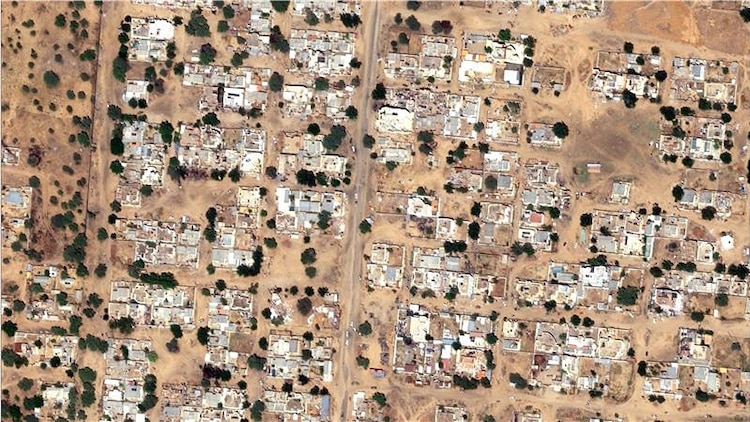
The Humanitarian Research Laboratory (HRL) at the Yale School of Public Health observed numerous clumps with discoloration around them, consistent with the appearance of human bodies in the Darfur region of Sudan.
Humanitarian Research Laboratory at the Yale School of Public Health
“Here, in the case of El Fasher, what’s different? They’re not burning the city to the ground. They’re surrounding it. They’re controlling entry and exit. And they’re moving quite systematically, unlike ZamZam. Quite systematically, block by block. And as they move, we see objects appearing as bodies, often with discoloration,” Raymond told ABC News.
Based on testimonies on the ground, those who fled said the men were separated from the women and children, who are likely now in hiding but will be next in the line of fire, Raymond said.
“This will now accelerate,” he said. “We haven’t even reached maximum speed. The people they are going to kill now are the ones who are hiding. And they are mainly women and children… Now it will be those who were too weak to flee or these men who were hiding and trying to protect them from the RSF.”


