
Georgina RannardClimate and science correspondent, Belém, Brazil
 EPA
EPAAfter bitter arguments, the UN COP30 climate summit in Belém, Brazil, ended with a deal that contains no direct reference to planet-warming fossil fuels.
It was a frustrating end for more than 80 countries, including the UK and the EU, who wanted the meeting to commit the world to more quickly stopping its use of oil, coal and gas.
But oil-producing countries have maintained their position that they should be allowed to use their fossil fuel resources to grow their economies.
The meeting comes as the UN says it fears global efforts to limit global temperature rise to 1.5°C above pre-industrial levels will fail.
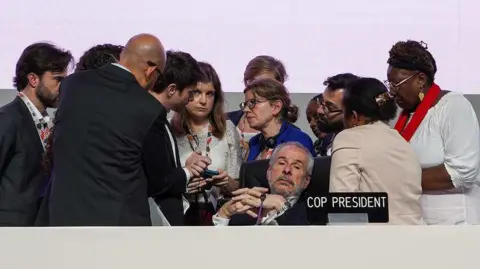
A representative from Colombia furiously criticized the COP presidency for not allowing countries to object to the deal at Saturday’s final meeting, known as the plenary.
“Colombia believes that we have sufficient scientific evidence that more than 75% of global greenhouse gas emissions come from fossil fuels,” Daniela Durán González, Colombia’s climate delegate, told BBC News.
“So we think it’s time for the Climate Change Convention to start talking about this reality,” she added.
The final agreement, called Mutirão, calls on countries to “voluntarily” accelerate their action to reduce their use of fossil fuels.
For the first time, the United States did not send a delegation after President Donald Trump said the country would leave the historic Paris treaty that committed countries to action on climate change in 2015. He called climate change a “fraud.”
Jennifer Morgan, a veteran negotiator and former German climate envoy, told the BBC that the absence of the United States was a “hole” in the negotiations. The United States has often supported blocs like the EU and the United Kingdom.
“During a 12-hour negotiation overnight, when oil-producing countries put up strong resistance, with no one countering that, it was certainly difficult,” she said.
But for many countries, the fact that the negotiations did not break down or roll back past climate deals is a relief.
Antigua and Barbuda Climate Ambassador Ruleta Thomas said: “We are happy that there is a process that continues to work. […] where every country can be heard.”
At the final meeting, a representative from Saudi Arabia said: “Each state must be allowed to chart its own course, based on its respective circumstances and economies. »
Like many other major oil-producing countries, the country has argued that it should be allowed to exploit its fossil fuel reserves as others have done in the past.

 UNFCCC
The two weeks of negotiations were sometimes chaotic. The toilets ran out of water, torrential storms flooded the room and delegates struggled to get by in hot, humid rooms.
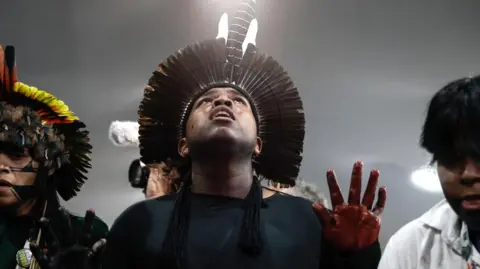
The approximately 50,000 delegates registered for the COP were evacuated twice. A group of around 150 protesters broke into the scene, breaching security lines and holding signs reading “our forests are not for sale”.
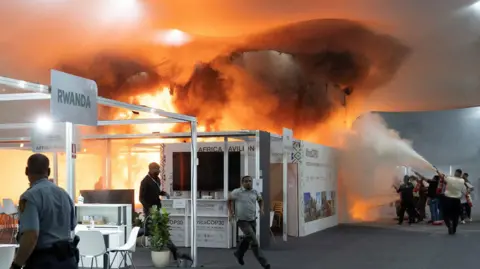
On Thursday, a large fire broke out, burning a hole in the roof and forcing participants to rush outside.
Brazilian President Luiz Inácio Lula da Silva chose the city of Belém to focus the world’s attention on the Amazon rainforest and to attract an influx of capital to the city.
Despite its desire for a more ambitious fossil fuel deal, Brazil has been criticized for its own plans to drill for oil at the mouth of the Amazon.
Its offshore oil and gas production is on track to increase until the early 2030s, according to analysis shared with the BBC by campaign group Global Witness.
 Reuters
Countries participating in the negotiations have competing interests, depending on their national circumstances and their exposure to the effects of climate change. Some countries were satisfied with the results.
India welcomed the agreement, calling it “significant”. A group representing the interests of 39 small island and low-lying coastal states on Saturday called it “flawed” but nonetheless a step toward “progress.”
Poorer countries have promised to increase climate finance to help them adapt to the impacts of climate change.
“It made things happen. There is a clearer recognition that those who have historical responsibility [countries that emitted more planet-warming gases in the past] have specific responsibilities regarding climate finance,” said Jiwoh Abdulai, Sierra Leone’s Minister of Environment and Climate Change.
 Reuters
But it’s a bitter ending for more than 80 countries, who negotiated through the night to keep tougher language on fossil fuels in the deal.
Britain’s Secretary of State for Energy and Climate Change, Ed Miliband, insisted the meeting was a “step forward”.
“I would have preferred a more ambitious agreement,” he said.
“We are not going to hide the fact that we would have preferred to have more, to have more ambition on everything,” EU climate commissioner Wopke Hoekstra told reporters.
With lush trees, bird calls and intense humidity, it was difficult to escape the Amazonian context of the negotiations.
Brazil has kicked off negotiations with a new fund called the Tropical Forests Forever Facility, which would pay countries to protect tropical forests. By the end of the meeting, he had raised at least $6.5 billion from governments, although the UK had yet to contribute.
More than 90 countries have backed the call for a global action plan against deforestation, or “road map.”
Additional reporting by Tom Ingham, BBC climate team



