
 AFP via Getty Images
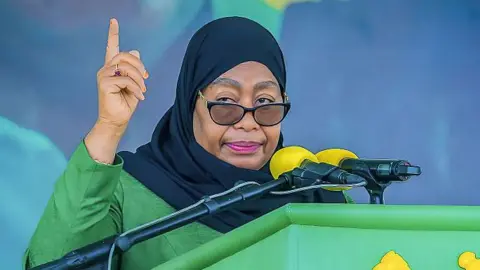
Tanzanian President Samia Suluhu Hassan was sworn in for a second term amid tight security, following an election marred by violent protests and dismissed by the opposition as a sham.
The inauguration ceremony took place on a military parade ground in the capital, Dodoma, instead of a stadium as in previous years. The event was closed to the public but was broadcast live on national television.
Samia was declared the winner on Saturday with 98% of the votes. She faced little opposition, with main rival candidates either imprisoned or prevented from running.
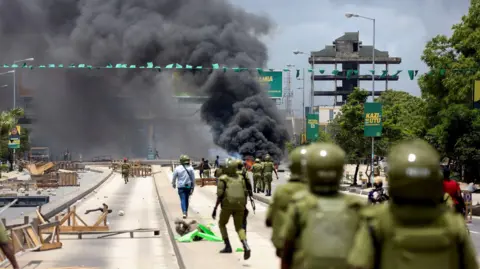
International observers have expressed concerns about the transparency of the elections and their violent aftermath, which reportedly left hundreds of people killed.
On Monday, election observers from the southern African regional body Sadc, of which Tanzania is a member, issued a strongly worded statement, saying that in most regions “voters were unable to express their democratic will.” Observers highlighted restrictions on the opposition and suspicions of ballot stuffing.
Authorities sought to downplay the scale of the violence. It has been difficult to get information about the country or verify the death toll because the Internet was cut nationwide from Election Day last Wednesday until Monday afternoon. Access remains severely restricted, including to social media sites and messaging platforms, internet monitor NetBlocks reports.
After taking the oath, President Samia thanked the electoral commission for organizing the elections with “indisputable efficiency”.
She expressed sadness over the violence which resulted in “loss of human lives and destruction of public property”, describing it as a stain on Tanzania’s image.
Some Tanzanians told the BBC they had not seen their loved ones since polling day.
A woman who asked to be identified only as Mama Kassim told the BBC that she had not seen her two sons since last Wednesday and had been unable to contact one of them.
“I don’t know where he is, I don’t know if he’s been arrested, I don’t know if he’s injured, I don’t know if he’s hospitalized, I don’t know if he’s dead.
“Oh my God, protect my son. He’s only 21,” she said.
Another Tanzanian told the BBC that due to lack of transport he had been unable to reach his home in Dar es Salaam from his workplace since Wednesday.
“I only had 10,000 shillings ($4) in my phone. I sent it to my family on Friday to buy food, but it was not enough and it was gone yesterday. I have no more money. My children are hungry,” he said.
Opposition leaders and activists said hundreds of people had been killed in clashes with security forces. The opposition Chadema party told the AFP news agency it had recorded “no less than 800” deaths on Saturday, while a diplomatic source in Tanzania told the BBC there was credible evidence that at least 500 people had died.
The Office of the United Nations High Commissioner for Human Rights earlier said there were credible reports of at least 10 deaths in three cities.
Following the unrest, prices of food, fuel and other basic necessities have doubled or tripled in many areas. Schools and colleges are closed and there is no public transport.
During his inauguration ceremony, attended by the presidents of Somalia, Zambia, Mozambique and Burundi, Samia ordered authorities to immediately ensure that people’s lives return to normal.
She said “it was not surprising” that some of those arrested were not Tanzanians, adding that security agencies were investigating.
Chadema – who was unable to contest – rejected the results announced by the electoral commission, saying they had “no basis in reality because the truth is that no real election took place in Tanzania”. He called new elections.
On election day, polling stations remained largely empty, but election officials later said turnout was 87 percent.

 Reuters
On Sunday, police spokesman David Misime blamed motorcycle drivers and foreign nationals for the violent protests and vandalism.
He said some individuals had “entered the country illegally with the intention of sowing chaos.”
Mr Misime urged Tanzanians to report to authorities “any foreigners who are unknown or whose activities in Tanzania are unclear”.
His remarks come amid reports that several Kenyan nationals have gone missing in Tanzania. Kenyan activist Hussein Khalid said on X that he had received reports of the death of a Kenyan teacher and others still missing.
The situation in Tanzania has sparked worldwide concern, with Pope Leo XIV calling for prayer on Sunday, saying post-election violence had broken out “with many victims”.
EU foreign affairs chief Kaja Kallas urged Tanzanian authorities to exercise restraint to preserve lives, while UN Secretary-General António Guterres said he was “deeply concerned” about the situation “including reports of deaths and injuries”.
The country’s two main opposition leaders did not participate in the elections: Tundu Lissu is detained on treason charges, which he denies, while Luhaga Mpina, of the ACT-Wazalendo party, was excluded on legal grounds.
Sixteen fringe parties, none of which have historically enjoyed significant public support, were allowed to run.
The ruling Chama Cha Mapinduzi (CCM) party and its predecessor Tanu have dominated the country’s politics and have never lost an election since independence.
Ahead of the election, rights groups condemned government repression, with Amnesty International citing a “wave of terror” involving forced disappearances, torture and extrajudicial killings of opposition figures.
The government rejected the claims and officials said the elections would be free and fair.
Samia took office in 2021 as Tanzania’s first female president following the death of President John Magufuli.
Learn more about Tanzania from the BBC:
 Getty Images/BBC




:max_bytes(150000):strip_icc():focal(749x0:751x2)/Charissa-Thompson-taylor-swift-travis-kelce-091025-59e09ded83994f92a43b9d98e0bef4b1.jpg?w=390&resize=390,220&ssl=1 "Charissa Thompson reveals how she learned that Taylor Swift and Travis Kelce got engaged (exclusive)")
